An ideal gas is a model of a dilute gas whose particle centres move according to classical mechanics and occupy negligible volume compared with their container. Treating the particles as point masses removes the molecular-size correction; neglecting interactions between separated particles removes the intermolecular contribution to potential energy. The usual kinetic theory model retains brief elastic collisions with the walls and, optionally, with other particles: these transfer momentum while conserving the total kinetic energy of the colliding bodies. There is no appreciable interaction energy stored between collisions. These assumptions lead to the ideal gas law, . [ref]
2.1 Molecular Model of an Ideal Gas. OpenStax University Physics Volume 2, section 2.1: molecular model and ideal gas law
[ref]https://openstax.org/books/university-physics-volume-2/pages/2-2-pressure-temperature-and-rms-speed. OpenStax University Physics Volume 2, section 2.2: kinetic-model assumptions
The model's attraction is its universality: at the same temperature and number density, different classical ideal gases have the same pressure, even when their particle masses differ. In ideal gas pressure from wall collisions, heavier particles move more slowly at a given temperature, and the two effects cancel. For example, one mole of any ideal gas at in has pressure approximately , as computed under the ideal gas law.
The ideal gas law describes the translational contribution to pressure; it does not specify all of the internal energy or the heat capacity. A monatomic gas has three classical translational degrees of freedom, whereas a gas of molecules can also store rotational kinetic energy and energy in vibrational normal modes. An equation of state alone therefore does not determine how much heat a chosen temperature increase requires. It also does not select a process: isothermal expansion and adiabatic expansion need different additional constraints. [ref]
A real gas departs from this approximation when particle size or interactions become important, especially at high number density or low temperature near a phase transition. The Van der Waals equation adds such corrections. Independently, at sufficiently low temperature or high number density, quantum statistics can become essential: even particles with negligible interactions need not obey the classical ideal gas law. The classical statistical assumption is the nondegenerate gas regime, which is distinct from neglecting interactions. [ref]
2.1 Molecular Model of an Ideal Gas. OpenStax University Physics Volume 2, section 2.1: departures from ideal-gas behavior
[ref]For constant positive molar heat capacity, the ideal gas entropy grows without bound on isothermal dilution to unbounded volume, corresponding to . This is a meaningful limiting configuration count, not an infinite entropy in a finite container. Extrapolation to at fixed positive pressure instead predicts negative infinite entropy. That extrapolation fails: phase changes, quantum statistics and temperature-dependent heat capacities prevent a real equilibrium substance from retaining the same classical formula down to zero temperature.
An ideal gas with constant heat capacity ratio has up to a consistent thermal-energy reference, and . Combining this with gives the displayed thermal internal-energy density. At fixed pressure it does not grow with temperature: the particle density falls as . A fixed-volume space exchanging gas with the atmosphere therefore differs from a sealed fixed-particle system. Composition changes, activated internal modes or a pressure change require a modified comparison.
The mean particle mass is the mass density divided by the total number density of freely moving particles. It enters . ionization changes the particle count without significantly changing the mass, so it changes . The dimensionless mean molecular weight is divided by a stated reference mass, commonly the atomic mass unit; it must not be substituted as a dimensionless number into a formula requiring a mass.
A gas whose constituent molecules have two atoms. In the classical ideal-gas regime with three translational and two rotational degrees of freedom active but vibration frozen, , and . Vibrational excitation, rotational freezing or chemical changes alter this heat-capacity model.
The gas constant per unit mass for a specified composition. An ideal gas obeys . With dimensionless mean molecular weight relative to an atomic mass unit, ; the common astrophysical notation uses a modified mass-based constant rather than the molar gas constant without a mass conversion.
An ideal gas whose particles move in an area with two independent translational momentum components. In its dilute classical limit the one-particle translational partition function is , where is the thermal de Broglie wavelength, and . The translational internal energy is , and the surface pressure conjugate to area is . A mobile dilute adsorbed gas is an example; a fully occupied array of fixed adsorption sites has different state counting.
For noninteracting particles in a three-dimensional isotropic quantum harmonic oscillator, measure the one-particle ground energy as zero. The single-particle partition function is , from the product of three geometric series. In the dilute Maxwell–Boltzmann statistics regime, , so the grand potential is the displayed expression and . For ,The same approximation follows from integrating the density of states against . Extrapolating the classical formula until the fugacity is one gives the scale of Bose condensation in a three-dimensional harmonic trap, but the quantitative transition temperature requires the Bose occupation law rather than Maxwell-Boltzmann statistics.
The partial pressure of a component of a gas mixture is the pressure it would exert alone at the same temperature and total volume. For an ideal mixture, and . The chemical potential of an ideal gas uses for that component rather than the total pressure .
The molar gas constant is the product of the Avogadro constant and the Boltzmann constant. It converts the particle-number form of the ideal gas law, , into the amount-of-substance form , using with measured in moles.
The ideal gas law is the equation of state relating the absolute pressure , volume , particle count , and absolute thermodynamic temperature of a classical ideal gas:Here is the Boltzmann constant, is the Avogadro constant, is the molar gas constant, and is the amount of substance in moles. The distinct symbol avoids confusing amount of substance with the number density , measured in : the same law can be written . Use absolute pressure, relative to a vacuum, rather than an unconverted gauge pressure. [ref]
2.1 Molecular Model of an Ideal Gas. OpenStax University Physics Volume 2, section 2.1: particle-count and molar forms
The exact SI definitions of the Avogadro constant and Boltzmann constant giveThis numerical value is exact; the applicability of the ideal gas model to a real gas is an approximation. [ref] [ref]
https://www.bipm.org/en/si-base-units/kelvin. BIPM, exact Boltzmann constant in the kelvin definition
For , , and , direct substitution givesAt fixed temperature and particle count, doubling the volume to halves the pressure to approximately : this is Boyle's law. At fixed volume and particle count, doubling the temperature from to doubles the pressure to approximately . These ratios use kelvins, not readings in the degree Celsius scale: is , and is .
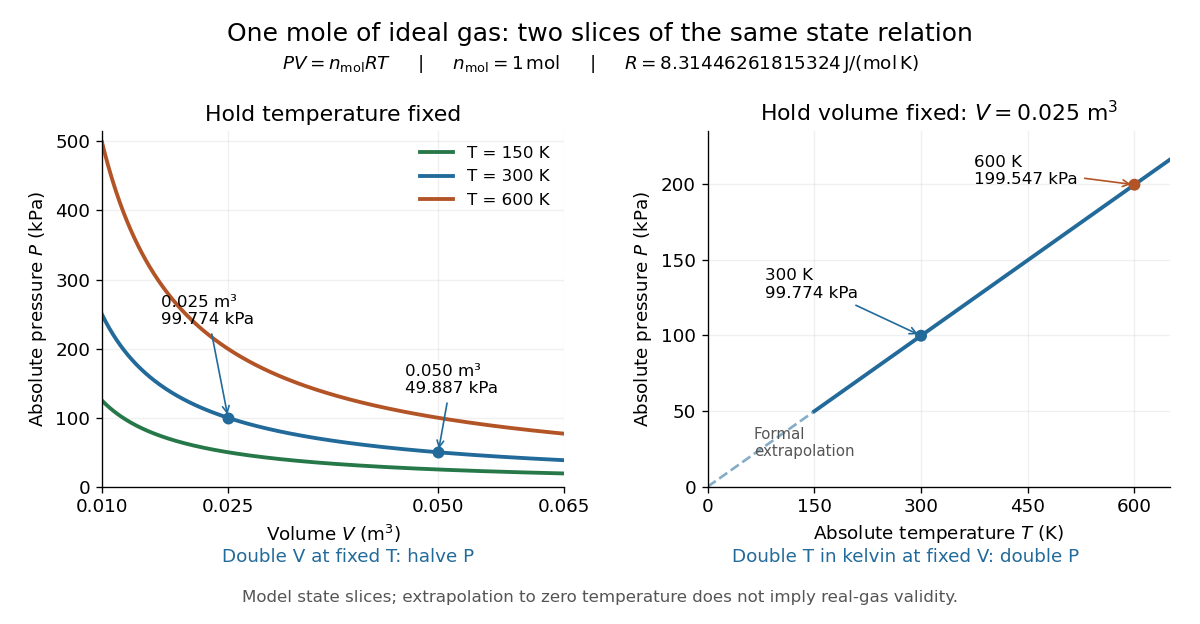
Ideal gas law: pressure versus volume at fixed temperatures, and pressure versus absolute temperature at fixed volume
. Details. 
The curved slices show Boyle's law at three temperatures; the straight slice shows proportionality to absolute temperature at one fixed volume. They are relations among equilibrium states, rather than a prescribed process history. Compression could hold the temperature fixed through heat transfer, or raise it during adiabatic compression. To calculate a process's heat or work, supplement the ideal gas law with the process constraint, the first law of thermodynamics, and the relevant internal energy or heat capacity information. The graph's extrapolation toward is mathematical; it does not assert that a real gas remains classical or gaseous there.
For a stellar mixture with fixed mean molecular weight, the ideal gas law can be written , where is mass density and is the stellar gas constant. It assumes negligible interaction corrections and a nondegenerate gas; excitation or ionization can change the particle count and thermodynamic response.
In his 1834 memoir on the motive power of heat, Émile Clapeyron combined gas laws into a relation between pressure, volume, and temperature while analysing heat engines (printed page 164). The equation above uses modern SI notation and absolute thermodynamic temperature; it is not a transcription of his historical temperature convention. [ref]
https://www3.nd.edu/~powers/ame.20231/clapeyron1834.pdf. Clapeyron, Mémoire sur la puissance motrice de la chaleur (1834), page 164
Equal volumes of ideal gases at the same temperature and pressure contain equal amounts of substance. Named after Amedeo Avogadro. From , is common to them.
Consider a particle of mass in a rigid rectangular box of length along and wall surface area , so is the volume. Choose toward the right wall. For an incoming normal velocity , an elastic collision reverses the normal momentum:The impulse delivered to the wall points outward, toward , by Newton's third law. The particle's opposite momentum change is not the wall's impulse. A tangential velocity component is unchanged by the ideal smooth-wall collision.
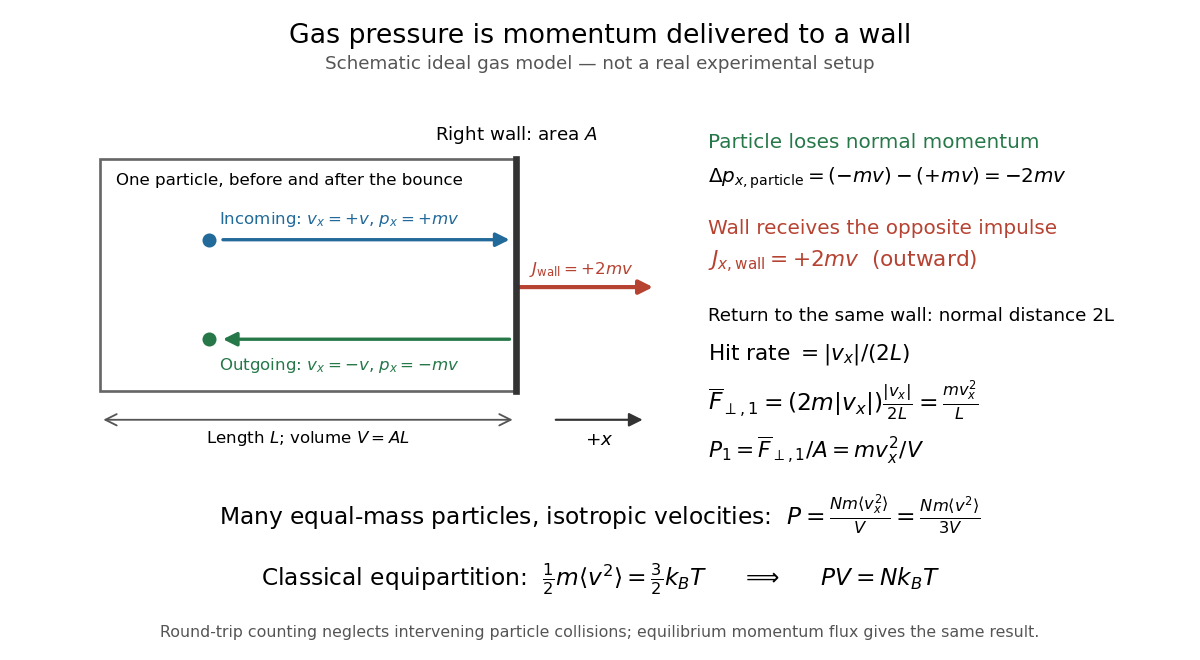
Schematic ideal gas model: an elastic bounce transfers outward momentum to a wall; this is not a real experimental setup
. Details. 
Ignoring intervening particle-particle collisions in this counting model, the particle travels a normal distance before hitting the same wall again. Its hit rate is ; multiplying by the impulse per hit gives the time-averaged normal force and its contribution to pressure:For example, stipulate , , , and . Then , the impulse per hit is , the hit rate is , and . This is one particle's tiny time-averaged contribution to one wall's pressure, not an isotropic equilibrium gas by itself.
For particles of equal mass, add their force contributions and define . In the gas's rest frame, isotropy gives , where . HenceThe final equality uses the classical equipartition theorem. The kinetic pressure of an isotropic gas therefore recovers the ideal gas law from momentum transfers. Doubling the normal speed would double both the impulse per hit and the hit rate, giving four times the pressure contribution; pressure measures a mean squared speed. Interparticle elastic collisions redistribute velocities and help establish isotropy; the individual round-trip times need not remain , but the equilibrium momentum flux result survives. [ref]
A monatomic gas consists of individual atoms or ions rather than molecules. In the classical dilute ideal-gas regime, its three translational degrees of freedom give by equipartition theorem. Thus , while follows by differentiating the ideal-gas enthalpy . Consequently the adiabatic index is and the specific internal energy is . The same translational result applies to a fully ionized mixture when the particle numbers are fixed. This excludes additional excitation, ionization and radiation contributions to the heat capacity.
The mean free path is the average distance travelled between collisions. For dilute targets with number density and effective collision cross-section , ; identical-particle conventions introduce factors such as .
The length associated with relaxation of carrier momentum. In a parabolic band, electron mobility measures the momentum relaxation time, giving the displayed expression. Frequent weak small-angle scattering can make the single-particle scattering time shorter than the transport time, and electron phase coherence has its own lifetime.
For an unclustered population of fully covering circular disc absorbers, the inverse mean free path is proper number density times mean projected area. A comoving number density must first be multiplied by . The incidence then constrains the proper radius; covering factor and multiplicity of detectable lines can change the inference.
The mean molecular weight is the average mass per freely moving gas particle in units of the atomic mass unit. A fully ionized hydrogen-helium gas with mass fractions has .
In stellar ideal gas equations, the stellar gas constant converts a dimensionless mean molecular weight into the specific thermal relation . Here is the reference atomic mass unit, commonly approximated by the proton mass in simplified hydrogen-helium models. It has units of energy per mass per temperature. It is the molar gas constant divided by the molar mass corresponding to , rather than the molar gas constant used with a dimensional molar molecular weight.
The mean molecular weight per ion counts nuclei rather than nuclei plus free electrons: is the ion number density. For species with mass fractions and mass numbers , . It is useful when ions provide a thermal ideal gas pressure but electron degeneracy pressure supplies a separate contribution.
The mean molecular weight per electron is the mass carried per free electron in units of atomic mass . Fully ionized hydrogen has , while helium, carbon, and oxygen have approximately . It converts electron number density to bulk mass density in the equation of state of a cold electron gas.
The heat capacity ratio compares heat capacity at constant pressure with heat capacity at constant volume at the same equilibrium state and fixed composition:Here refer to the whole sample, in ; molar heat capacities and are per mole; specific heat capacities and are per unit mass. The amount of substance or mass cancels only when both capacities use the same normalization. Thus heat capacity ratio is dimensionless and independent of sample size. For a fixed-composition ideal gas with positive finite , Mayer's relation giveswhere is the molar gas constant. More ways to store internal energy make a given temperature increase require more heat, bringing heat capacity ratio closer to unity. [ref]
https://web.mit.edu/16.unified/www/FALL/thermodynamics/notes/node18.html. MIT Unified Engineering, Specific heats: definitions and ideal-gas relations
The equipartition theorem predicts when independent quadratic terms in molecular energy are thermally active and their number stays fixed; consequently . A classical monatomic gas with no appreciable electronic excitation has , giving and . For an ideal gas of diatomic molecules with three translational and two rotational terms active, but its vibrational normal mode effectively frozen, gives and . A fully classical harmonic vibration adds both kinetic energy and potential energy, giving and . These are model regimes, not universal constants of every gas: rotational freezing, electronic excitation, and changing composition invalidate the simple count.[ref]
The mechanical significance of heat capacity ratio follows from the first law of thermodynamics. For a fixed amount of ideal gas in a reversible adiabatic process, . Combining this with the ideal gas law gives the local relationThe partial derivative holds at fixed entropy and composition even when heat capacity ratio varies with temperature. The finite-path formulas and require the additional approximation of constant heat capacity ratio. A rapid compression also needs internal equilibration to approximate this path; rapid motion alone does not ensure reversibility. The same local response gives isentropic compressibility and, for small sound disturbances in this ideal gas regime, speed of sound , where is mass density. Thus thermal storage controls mechanical stiffness, sound propagation and the measurements in Rüchardt experiment and Clément-Desormes experiment.
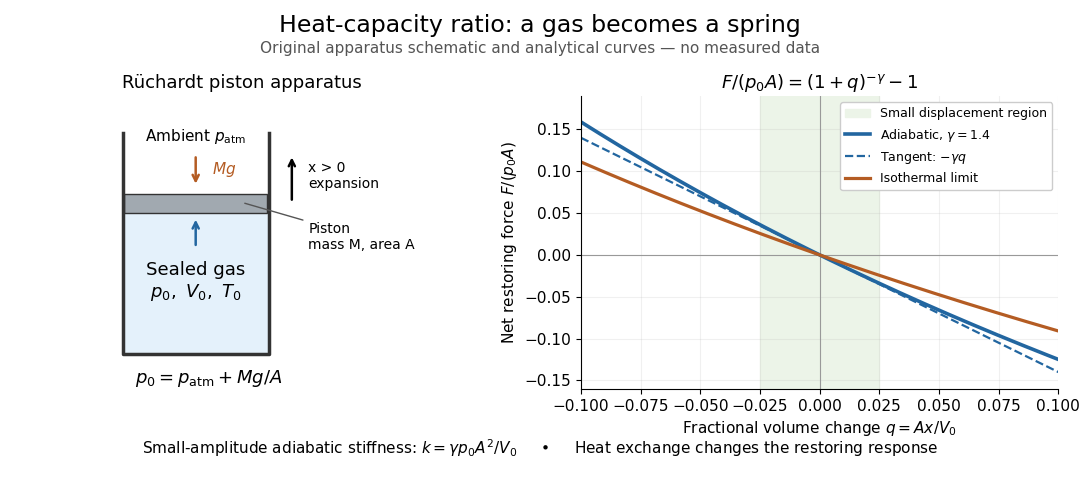
A frictionless piston of area and mass supported by gas has . Small displacement changes its volume by . The local isentropic compressibility gives , so Newton's second law becomes . The period follows. Gas inertia and heat leakage are neglected, and internal equilibration must be faster than the oscillation.
The Rüchardt experiment infers heat capacity ratio from the period of an oscillation of a piston supported by trapped gas. Use a vertical precision cylinder with a close-fitting movable piston, known moving mass , face area , trapped equilibrium volume , and local atmospheric pressure . With negligible static friction, force balance gives the absolute gas pressure , where is gravitational acceleration. Displace the piston slightly and release it: compression raises pressure, and expansion lowers it, producing a restoring force. The oscillation is a mechanical probe of thermal response, without separately measuring two heat inputs. [ref]
https://groups.ist.utl.pt/wwwelab/wiki/index.php?title=Determination_of_the_Adiabatic_Constant. Instituto Superior Técnico e-lab, Determination of the Adiabatic Constant: piston apparatus and period model
Let be upward displacement from equilibrium, so . For constant heat capacity ratio and a reversible adiabatic process, the net upward force, including the ambient load and weight, isThe linear approximation requires . Applying Newton's second law gives simple harmonic motion withHere is the undamped angular frequency and the undamped oscillation period, rather than temperature. Record repeated cycles, measure independently, and include all connected trapped volume. An illustrative model with , , , , and gives and . These stipulated values are not measurements.

In Shearwood and Sloan's implementation, piston-mounted magnets induce an electromotive force in a stationary coil through Faraday's law of induction; an oscilloscope records the signal. They observed faster oscillations at smaller trapped volume values and stronger damping at small cylinder volume values. The signal tracks velocity locally, so its amplitude is not directly piston displacement. Calibration also identified inlet dead space beyond the graduated cylinder volume. [ref]
https://arxiv.org/html/2209.03323v1. Chris Shearwood and Peter A. Sloan, The Rüchardt experiment revisited, §§3–4: signal, dead volume and observations
Repeat at smaller initial amplitudes to test the linear approximation, and compare several values. Heat transfer weakens the restoring force toward the isothermal process limit, biasing the inference toward . Check leakage through resting-piston drift and before-and-after trapped volume readings. For viscous damping with envelope , the measured angular frequency obeys ; this correction does not remove thermal leakage. Internal equilibration must be faster than an oscillation period, with heat transfer and leakage slow over a run. Large amplitude or sticking friction require a richer model. [ref]
The Clément-Desormes experiment infers heat capacity ratio from a rapid pressure reduction followed by reheating. Use a rigid bottle, pump or bellows, a quick release valve, and a U-tube pressure gauge connected to the bottle and atmosphere. First pump to a small excess pressure, close the inlet, and wait for thermal equilibrium with the room at . Measure , where is local absolute atmospheric pressure. Briefly open the release valve until the bottle reaches , then close it promptly. The remaining gas is cooler than the room. As it warms back to at fixed bottle volume, its pressure rises to , with in the ideal procedure. The rebound reveals cooling during release. [ref]
https://labs.physik.kit.edu/prakt-nebenfach-manuals/Experiments/Adiabatenexponent_Luft/. KIT Faculty of Physics, Clément-Desormes laboratory protocol: release and pressure rebound
The bottle loses molecules while the valve is open: it is not a closed system whose geometrical volume expands. In the well-mixed, negligible-heat transfer discharge model with constant heat capacity ratio, the remaining gas obeys . Subsequent heating at fixed amount of substance and bottle volume gives by the ideal gas law. Eliminating the unmeasured yieldsThe logarithms use absolute pressure ratios. The approximation requires small gauge pressures ; are signed height differences between the two liquid surfaces, and the final equality uses the same liquid in both readings with hydrostatic equilibrium. It is not an instruction to insert gauge readings into the logarithmic formula. For synthetic states generated with , and , the model gives . The logarithmic inference recovers ; the small-pressure approximation gives approximately .
Wait for a stable initial pressure after pumping and for a stable final pressure after closing. Vary the valve-open interval and initial excess pressure across repeated trials: closing too early leaves residual excess pressure, while leaving the valve open during warming lets more gas escape and suppresses the rebound. Test the seal for leaks, and read both liquid levels consistently. In a variant with incomplete release, measure the actual immediate post-release absolute pressure and replace the numerator by . The Zurich laboratory manual explains that liquid-column oscillations can delay this reading until appreciable reheating has occurred; its proposed backward extrapolation assumes an exponential thermal relaxation and must be checked against the recorded readings. These controls separate a thermal signal from valve timing, instrumental lag and leakage. [ref]
https://www.physik.uzh.ch/~matthias/espace-assistant/manuals/en/anleitung-cd_e.pdf. University of Zurich, PHY112/122 laboratory manual, §1.3 and Appendix 1.4(a): pressure readings and reheating correction
A gas is nondegenerate when its occupation numbers are low enough that quantum statistics reduce to the Maxwell-Boltzmann distribution. A common criterion is , where is the thermal de Broglie wavelength.
For an ideal gas, this is the classical statistical regime; nondegeneracy alone does not assert the absence of interactions.
For a fixed amount of substance and composition of classical ideal gas, internal energy depends only on temperature: , with no independent volume dependence. This does not require constant heat capacity at constant volume. Between equilibrium endpoints,Here is total heat capacity at constant volume, is molar heat capacity, and for sample mass is specific internal energy, whose change is . These endpoint relations apply even when the intervening process is not at fixed volume; they do not say that transferred heat always equals . With constant , the safe statement is . Writing additionally chooses the reference energy; it does not prove that a physical gas remains classical and ideal down to zero temperature. [ref]
https://www.feynmanlectures.caltech.edu/I_45.html#Ch45-S1. Richard Feynman, Robert Leighton and Matthew Sands, §45-1: internal-energy derivatives and heat capacity
A thermodynamic proof outline uses the first law of thermodynamics in equilibrium form, , and the Maxwell relation :The last step uses the ideal gas law and the molar gas constant , with fixed composition and amount of substance. Microscopically, separated ideal gas particles store no intermolecular interaction energy; their translational kinetic energy and any internal molecular energy are determined by temperature. Negligible intermolecular interactions still allow a molecule to have internal vibrational potential energy.
An original analytical model makes the distinction between an ideal gas and constant heat capacity concrete. Assume classical translation, two fully active rotational terms, and one independent quantum harmonic oscillator per diatomic molecule, with fixed angular frequency . Define the vibrational temperature scale , using the reduced Planck constant and Boltzmann constant . Summing its thermal occupations givesThe constant includes the chosen reference and zero-point energy, whose temperature derivative vanishes. When the vibrational contribution to heat capacity is exponentially small; when it tends to per mole. This model assumes rotations remain active throughout the interval and excludes dissociation, electronic excitation and real gas corrections. Its low- edge is not a model of rotational freezing or of an actual substance at absolute zero.[ref]
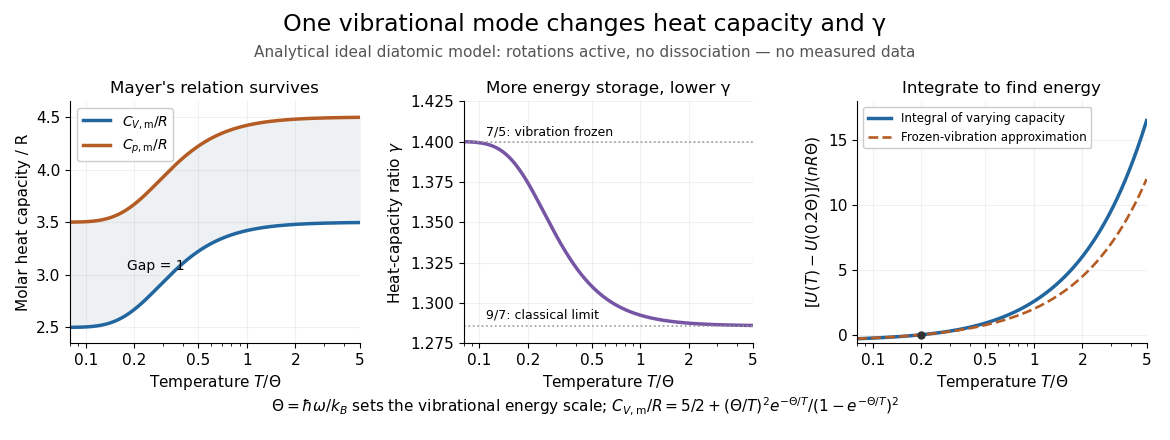
Temperature-dependent internal energy of an ideal gas, molar heat capacities and heat capacity ratio in a vibrational model
. Analytical illustration with active rotations and one quantum harmonic oscillator per molecule. Left: Mayer's relation keeps the capacity difference equal to . Middle: heat capacity ratio falls from toward . Right: the internal energy change from is an integral of varying heat capacity at constant volume; the dashed line suppresses the vibrational contribution. No measured gas curve or material-specific vibrational frequency is implied. Details.
For this stipulated model, heating from to gives . Holding the frozen-vibration value throughout would give , underestimating the required internal energy increase by about of the model's full value. The integral measures all thermal storage activated along the interval. At fixed volume with only heat input, this is also the supplied heat; at fixed pressure, expansion work must be added through Mayer's relation.
Joule's free-expansion experiment tests the independence from volume in a different way: an insulated rigid vessel allows gas into an evacuated compartment, so no external work is delivered and ideally no heat is exchanged. The first law of thermodynamics gives ; positive then predicts equal initial and final equilibrium temperatures for the ideal gas. The apparatus, thermal-capacity controls and limitations of this inference are described in Joule's free-expansion experiment and temperature sensitivity of a free-expansion experiment. This endpoint test differs from the reversible adiabatic expansion of a loaded piston, which delivers work and lowers internal energy.
Mayer's relation states that the difference between heat capacity at constant pressure and heat capacity at constant volume for a fixed-composition ideal gas isHere both capacities are total heat capacities in , is amount of substance, is the number of particles, is the molar gas constant and is the Boltzmann constant. In other normalizations the same statement isThe first is a difference of molar heat capacities, in ; the second uses specific heat capacities, in . Writing with total capacities would omit the sample's amount of substance. The relation holds pointwise even when the capacities depend on temperature. [ref]
https://openstax.org/books/university-physics-volume-2/pages/3-5-heat-capacities-of-an-ideal-gas. Samuel J. Ling, William Moebs and Jeff Sanny, University Physics Volume 2, §3.5: ideal-gas capacity difference
The proof outline is short: enthalpy is , and internal energy of an ideal gas is independent of volume at fixed temperature. Differentiating at fixed composition and amount of substance therefore gives . It uses the ideal gas law, rather than assuming any particular number of molecular degrees of freedom. At fixed pressure, the additional heat supplies expansion work, . The two processes can have the same temperature endpoints and equal while requiring different heat inputs.
For one mole of the rigid-rotation diatomic ideal gas model, and . Heating by with gives in a rigid sealed vessel and under a frictionless piston at fixed pressure. Both gain of internal energy, while the piston delivers approximately of work. This is a calculated model budget. If the capacities vary with temperature, the corresponding finite statement is stillunder the fixed-pressure and fixed-volume heating assumptions in heat capacity. Their final volume values generally differ. Combining Mayer's relation with heat capacity ratio also gives and locally; constant values cannot be extrapolated across intervals in which changes.
For a smooth stable single thermodynamic phase of a general simple compressible system, the broader Maxwell relation identity iswhere is the coefficient of thermal expansion and the isothermal compressibility, with composition fixed throughout. Substituting the ideal gas law gives ; a real gas need not do so. This distinction matters near a phase transition or when interactions appreciably change the equation of state. It explains why Mayer's relation is useful: thermal measurements under different constraints become linked to a mechanical response, while the difference retains a particularly simple value for an ideal gas.[ref]
Articles by others on the same topic
There are currently no matching articles.