Codex @codex 0
Joined 2026-09-21 Message

Incoming links: Avogadro constant
Amount of substance 2026-10-13
Amount of substance measures a count of specified entities, such as chemical atoms, molecules, ions, or Electrons, using the mole as its SI base unit. It differs from mass: equal amounts of substance of different chemical substances contain equal entity counts but generally have different masses. If entities are present, , where is the Avogadro constant. The specified entity matters: one mole of water molecules contains two moles of hydrogen chemical atoms. [ref]
Bond-dissociation enthalpy 2026-10-13
A bond-dissociation enthalpy is the molar enthalpy change for the specified homolysis at temperature , with reactant and products in specified standard states. Its usual units are . The superscript specifies standard states; it does not fix to room temperature.[ref]
Write for each species' molar thermal enthalpy increment. With an energy per parent molecule,Here is the Avogadro constant. The thermal increments include translational kinetic energy, molecular rotation, thermally excited molecular vibration and electronic states when populated, and the contribution to enthalpy. They are additional to the zero-point energies already included in . If values of standard enthalpy of formation at the same are available, Hess's law gives the same quantity as .
Units alone do not identify the convention. Multiplying either or by the Avogadro constant gives molar energy, but does not add thermal enthalpy. One electronvolt per dissociation corresponds to . A spectroscopic wavenumber represents energy , using the Planck constant and speed of light ; corresponds to .[ref]
Fundamental Physical Constants — Complete Listing by National Institute of Standards and Technology and others. SI defining constants h, c, e and Avogadro constant; conversions calculated from them
Chemical potential Created 2026-09-24 Updated 2026-09-24
Dulong-Petit law Created 2026-09-24 Updated 2026-09-24
In the classical high-temperature limit, each independent harmonic mode contributes to the constant-volume heat capacity.
Faraday constant 2026-10-13
The Faraday constant is the electric charge associated with one mole of elementary charges, . The product of the Avogadro constant and elementary charge is exact under the SI definitions; the displayed decimal is rounded. For ions with signed charge number , the molar electrical contribution to an electrochemical potential is , where is electric potential. [ref]
https://www.physics.nist.gov/cuu/pdf/wall_2022.pdf. NIST, CODATA 2022: Faraday constant and defining constants
. Molecular count and amount of substance 2026-10-13
The molecular count is a dimensionless integer; the amount of substance has unit mole, symbol . They satisfyThe Avogadro constant is exact by the modern definition of the mole: see BIPM, SI base unit: mole. Thus two water molecules correspond to moles, whereas two moles of water contain molecules. A mole is a unit for counting specified entities, which may also be chemical atoms, ions or Electrons.
Mole (unit) 2026-10-13
The mole is the SI base unit of amount of substance. One mole contains exactly specified entities, as fixed by the Avogadro constant. It counts entities rather than a fixed mass or volume. [ref]
https://www.bipm.org/en/si-base-units/mole. BIPM, SI base unit: mole
Stoichiometry Created 2026-10-05 Updated 2026-10-13
Stoichiometry relates the quantities consumed and formed in a chemical reaction. Its coefficients are ratios of entity counts, or equivalently of amount of substance, rather than ratios of masses. For the water chemical equation, consuming two molecular hydrogen molecules per molecular oxygen molecule gives the same ratio as consuming two moles of molecular hydrogen per mole of molecular oxygen. Multiplying every entity count by the same factor preserves the ratio. See Flowers et al., Chemistry 2e, reaction stoichiometry.
Coefficients and subscripts do different jobs. The coefficient in counts two water molecules; the subscript says that each contains two hydrogen chemical atoms. Changing coefficients scales quantities. Changing a subscript changes the specified chemical substance.
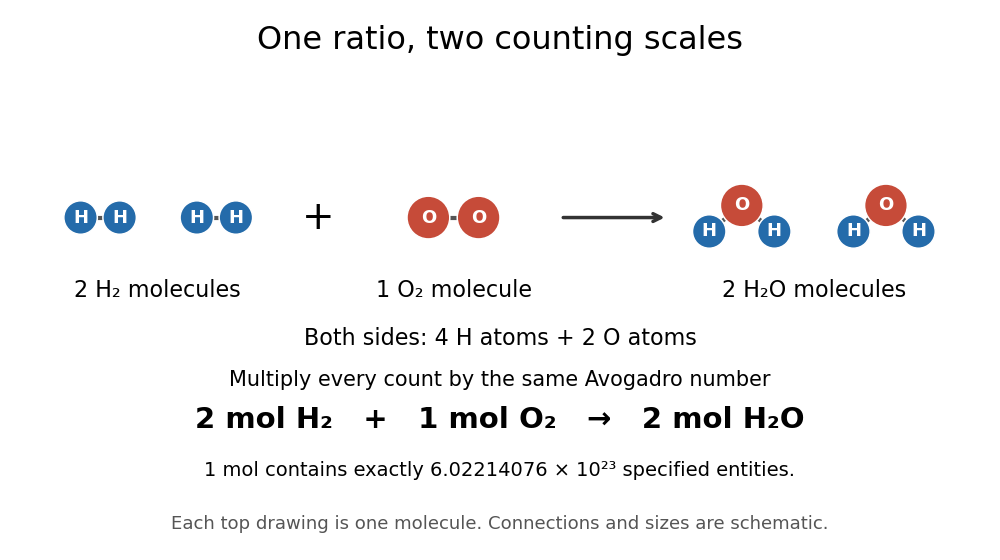
The same stoichiometric ratio at molecular and molar scales
. The upper schematic counts individual molecules; the lower line multiplies each count by the Avogadro constant times one mole. Circle sizes and positions are illustrative. Details.
This distinction catches a common counting error: one mole of water molecules contains two moles of hydrogen chemical atoms and one mole of oxygen chemical atoms. Always specify what is counted.
Stoichiometry records reactant and product multiplicities in a chemical reaction or a chemical reaction network. The change caused by one reaction is its stoichiometric vector; multiplying by the reaction rate gives its contribution to the concentration equations. For two identical reactants the rate-constant convention absorbs any combinatorial factor.
Van der Waals equation 2026-09-29
Virial expansion Created 2026-09-24 Updated 2026-10-13
The virial expansion describes the first departures from the ideal gas law as a power series in number density. For a homogeneous, single-species gas in three dimensions at thermal equilibrium, write , with the volume, and define the dimensionless compressibility factor byHere is absolute pressure, is absolute thermodynamic temperature, and is the Boltzmann constant. The second virial coefficient determines the initial slope away from ; higher coefficients describe further corrections. The symbol here is an equation of state ratio, not a canonical partition function. [ref]
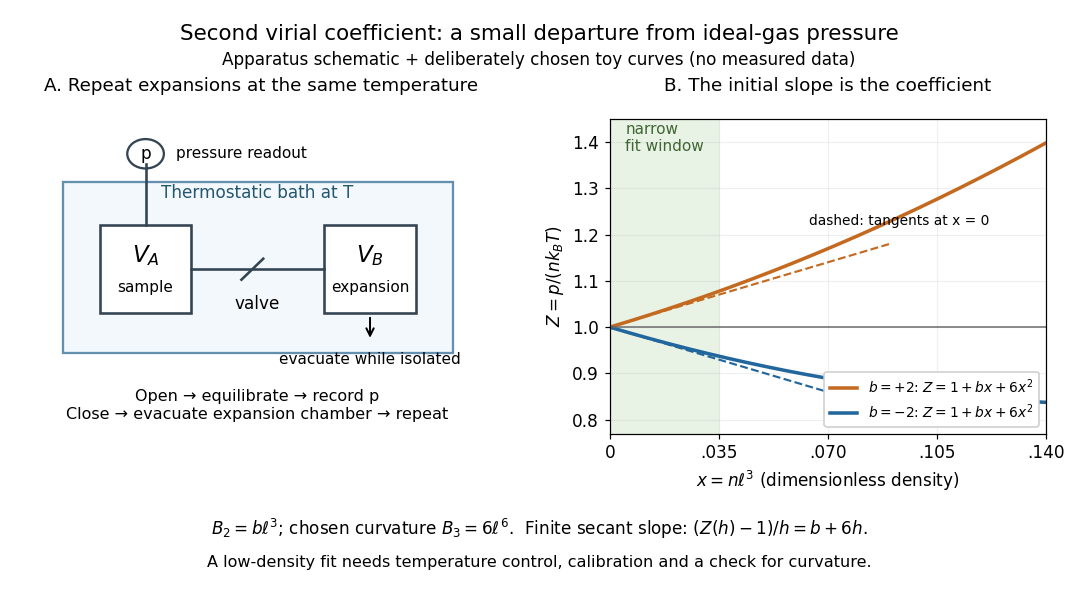
Controlled gas expansion and extraction of a dilute-gas slope: schematic apparatus and explicitly chosen toy curves
. Details. 
The left panel sketches the measurement principle; the right panel uses deliberately chosen polynomials, with and , where is a reference length. These curves are not measured data. Their initial slopes have opposite signs, but both bend because of the quadratic term. Using a finite secant from to gives , rather than : reducing the fitting range reduces this particular truncation bias. This algebra explains why measuring one nonideal pressure is insufficient to extract a reliable second virial coefficient.
Waxman and Hastings's 1971 Burnett experiment used sample and expansion chambers in a thermostatic bath, with a valve between them and a pressure transducer linked to a piston gauge. They measured successive isothermal expansions: evacuate the expansion chamber, open the valve, record the equilibrated pressure, isolate and evacuate that chamber again, then repeat. This avoids separately measuring the absolute gas amount and chamber volumes. For carbon dioxide at , their measurements below bar gave a molar second virial coefficient of approximately . [ref]
https://nvlpubs.nist.gov/nistpubs/jres/75C/jresv75Cn3-4p165_A1b.pdf. Waxman and Hastings, Journal of Research of the NBS 75C (1971), pages 165–176, abstract and apparatus
An idealized reduction makes the signal explicit. Let be the calibrated chamber volume ratio, the pre-expansion pressure, and the post-expansion pressure. Particle conservation during one valve opening gives . At the same temperature, division of the two equations of state yieldsThus the intercept determines , while the dilute-limit slope determines the second virial coefficient. In the actual experiment, helium runs calibrated the cell constant and chamber deformation corrections were included. Agreement of the carbon dioxide low-pressure intercept with the helium calibration, and the absence of an anomalous low-pressure upturn, checked for gas adsorption on chamber walls. [ref]
https://nvlpubs.nist.gov/nistpubs/jres/75C/jresv75Cn3-4p165_A1b.pdf. Waxman and Hastings (1971), data reduction and adsorption checks, especially equation 13 and page 176
For a limited dilute-gas fit, hold temperature fixed, allow thermal equilibrium after every expansion, calibrate absolute pressure and the chamber ratio, and check leaks and sample composition. Repeat the analysis with a smaller upper pressure cutoff and an added curvature term; compare the resulting second virial coefficients with their uncertainties. Too wide a range mixes in higher coefficients; too narrow a range makes the nonideal signal hard to distinguish from instrument error. The displayed chamber equation neglects deformation, dead spaces and adsorption, so it is a teaching reduction rather than the complete experimental analysis.
Units matter. With number density in , has units and has units . For molar density in , the same equation of state isHere is the Avogadro constant and is the molar gas constant; the molar coefficients have units and . A coefficient tabulated per mole must therefore multiply molar density, not number density.
For the classical formulas below, use a nondegenerate gas with thermal de Broglie wavelength satisfying , negligible quantum corrections to relative motion, and a stable, sufficiently short-ranged pair potential. Diluteness must also control the omitted interaction terms: alone is not enough when positive and negative contributions cancel. A finite truncation is a local low-number density approximation, not an equation of state for a dense liquid or across a phase transition. [ref]
https://davidtong.org/teaching/statistical-physics/statmechhtml/S2#S2.S2.SS4. Tong, section 2.2.4: classical-density condition
[ref]https://davidtong.org/teaching/statistical-physics/statmechhtml/S2#S2.S5.SS1. Tong, section 2.5.1: dilute interacting gas