The central system of protons and neutrons in an atom. Its mass number is its baryon number in ordinary nuclear states; is the proton number and the neutron number.
The nucleus contains almost all of an atom's mass and carries positive electric charge , where is the elementary charge. The atomic number identifies the chemical element; changing at fixed gives another isotope. The mass number counts nucleons, rather than specifying the exact nuclear mass: nuclear binding energy lowers the mass of a bound system relative to its separated constituents. The simplest nucleus is a single proton; other atomic nuclei can contain many protons and neutrons bound by the nuclear force.
A nuclear quantum state has properties such as spin and a spatial nuclear charge distribution. These are different questions from merely counting nucleons. A small-angle elastic scattering measurement can reveal a nuclear charge radius, while a wider range of momentum transfer tests the distribution's shape. The Hofstadter nuclear electron scattering experiment made this connection between scattering patterns and nuclear structure experimentally concrete.
A transition-operator matrix element between specified nuclear states. It combines their many-nucleon wavefunctions with the relevant interaction operator. In double beta decay, different assumed mechanisms and nuclear-structure calculations give different matrix elements, so converting a half-life bound to a neutrino-mass bound requires that input. A measured energy endpoint alone does not determine it.
The approximate mass-number dependence of a sharp equivalent nuclear radius. Near-constant interior nucleon number density gives , hence . A conventional matter-radius scale is , with isotope and definition dependence. A charge-weighted root-mean-square radius is a different observable: for a uniform sphere it is . Diffuse surfaces and neutron skins prevent interpreting the scaling as a universal hard boundary.
A nuclear excited state lies above the same nucleus's ground state in internal energy. spin, parity and approximate isospin help classify it. Single-particle rearrangements, broken pairs and collective deformation/vibration give different excitation patterns and can mix. Below particle-emission thresholds, gamma decay and internal conversion are important de-excitation routes; an excitation energy is not necessarily the energy of every emitted gamma ray in a cascade.
A nuclear isomer is a relatively long-lived metastable nuclear state. Gamma de-excitation can be hindered by a large angular-momentum change, high electromagnetic multipolarity or small overlap with lower states. Its lifetime and decay channels depend on the actual level structure; metastability is not an absolute prohibition on decay.
An atomic nucleus with odd proton number and odd neutron number. Both unpaired species can contribute to the total nuclear spin; addition of angular momentum gives possible couplings, while the nuclear residual interaction determines their ordering.
Nuclear isobars are different nuclides with the same mass number and different atomic numbers . They differ from isotopes, which have fixed . Beta decay connects neighboring nuclear isobars.
The total angular momentum of an atomic nucleus, including the orbital and intrinsic spin contributions of its constituent nucleons.
The electric quadrupole moment of an atomic nucleus, conventionally specified in its stretched nuclear spin state. It measures a nonspherical nuclear charge distribution. Its interaction with the electronic electric-field gradient contributes to hyperfine structure and generally changes the magnetic-dipole Landé interval rule. A permanent rank-two moment vanishes for nuclear spin less than one.
The magnetic dipole moment associated with nuclear spin, using dimensionless angular momentum operators and the nuclear magneton . The quoted scalar moment is its expectation in the stretched quantum state, . In the same electronic energy level, the leading magnetic-dipole hyperfine structure constant is proportional to , apart from isotope-dependent electronic and nuclear-size corrections.
A nuclear level scheme represents nuclear energy levels and transitions among them. Gamma ray energies constrain pairwise differences; emission counts and coincidence measurements help resolve different schemes having the same difference multiset.
For a complete ensemble of downward nuclear de-excitation cascades, let be the direct population of excited level and the total number of transitions from to . Conservation of population gives the displayed outward-minus-inward formula. A negative rules out a proposed scheme under the assumed complete transition inventory. Gamma ray counts equal transition counts only when unreported internal conversion and other competing paths can be neglected or corrected. Summing over all excited levels cancels internal transitions and leaves the transitions into the ground state.
Nuclear de-excitation is a transition from a higher to a lower nuclear energy level. It can transfer energy to an emitted gamma ray or to an atomic electron through internal conversion, among other channels when thresholds permit.
Internal conversion transfers nuclear excitation energy directly to a bound atomic electron, which is emitted, rather than to a real gamma ray. Photon counts alone then underestimate the number of nuclear transitions unless the conversion contribution is included.
Gamma decay is electromagnetic nuclear de-excitation by photon emission. It preserves mass number and atomic number, while changing the nuclear state. Angular momentum and parity constrain the allowed radiation multipoles. The gamma ray topic is broader than this nuclear process.
Named for Victor Weisskopf, a Weisskopf estimate is a benchmark electromagnetic nuclear transition strength based on a simple single-particle size model. It supplies a scale against which enhancement or hindrance is measured, rather than a universal rate. The partial rate contains both the photon-energy power and the actual reduced nuclear strength. Electric and magnetic multipoles at different energies cannot be universally ranked by order alone.[ref]
Guidelines for Nuclear Structure Evaluators by Murray J. Martin. Appendix C, printed pp.60–67
For a prompt nuclear level fed in a steady decay cascade, incoming and outgoing transition populations balance. Quoted photon intensities must represent efficiency-corrected emission counts; internal conversion, alternative particle decays and unobserved feeds must either be included or explicitly excluded. Equal photon counts suggest a serial cascade, while a feed intensity equal to the sum of two branches suggests splitting. intensities alone do not determine the chronological order of equal-count lines.
Reconstructing a nuclear gamma scheme amounts to assigning measured photon energies to differences between ordered level energies. Cascade energy sums constrain the graph, while population-flow balances constrain its orientation and feeding. Experimental central energies need not close exactly; a weighted least-squares energy-network fit uses their uncertainties consistently. Multiple graphs can satisfy the same spectrum when coincidence or lifetime information is absent.
A real photon emitted in gamma decay carries a radiation multipole of integer angular momentum . The triangle rule gives the displayed range. An electric multipole requires , while a magnetic multipole requires . There is no real single-photon decay; an electric monopole transition can instead proceed through internal conversion or, above threshold, pair creation. In the long-wavelength regime , increasing usually strongly suppresses the rate, but nuclear transition matrix elements and collective enhancement can make an allowed lower multipole weaker than a higher one.
An absent otherwise-fast gamma transition can support a spin assignment that forbids it. It is not an absolute selection rule: a nuclear reduced matrix element may be small even when angular momentum and parity allow the mode. Meaningful limits require detection thresholds, branching normalization and competing-channel information. Assuming ordinary unhindered strengths can yield a useful conventional assignment, but that assumption must be distinguished from strict observed-line constraints.
If a cascade determines only absolute spin differences relative to a known reference spin, reflection of all inferred spins around that reference can preserve the same multipole pattern. Nonnegative-spin constraints, independently known spins, angular correlations or polarization measurements may break the ambiguity. A set of line energies and lowest-multipole labels need not do so.
Movement of an atomic nucleus after it receives momentum, for example in a collision. A finite nuclear mass requires sharing kinetic energy as well as momentum; the fixed-target approximation neglects this motion.
The relative light or charge yield of a nuclear recoil compared with an electron recoil at the same deposited energy in a specified material and field configuration. It connects an electron-equivalent calibration scale with a recoil-energy scale. It can depend on energy and measurement conditions; assuming a constant or extrapolating below calibration changes light-WIMP interpretations. It does not mean energy conservation fails: energy can enter channels not measured by that readout.
For nonrelativistic elastic scattering of a WIMP of mass from a stationary nucleus of mass , the reduced mass is . In the centre-of-momentum description, a scattering angle gives momentum transfer squared . The target kinetic energy is , giving the displayed maximum at backscattering. In SI units, using masses in kilograms and velocity in metres per second gives joules. Low recoil energy and a falling recoil spectrum make threshold and response calibration important for dark-matter direct detection.
An elastic scattering event leaves the nuclear internal quantum state unchanged while transferring energy to its motion. Let a target of mass initially be at rest. Neglect the electron rest mass, but retain relativistic target recoil. Conservation of momentum and conservation of relativistic energy giveEliminating yields and henceThe static relation follows only when is negligible. For small recoil, ; this last approximation is nonrelativistic for the recoiling nucleus, not for the incident electron. The invariant spacelike transfer, expressed in energy-squared units, isso and the spatial inverse length coincide only in the static limit. Recoil kinematics alone does not correct the static differential scattering cross-section: a finite-mass target also changes its kinematic prefactor and the appropriate current matrix elements.
The helium-four atomic nucleus, containing two protons and two neutrons. Its ground-state spin and isospin are zero. A quantized cubic four-Skyrmion supplies a corresponding nuclear state in the soliton description.
The bound atomic nucleus containing one proton and one neutron. Its ground-state spin is one and its isospin is zero. The appropriately quantized toroidal two-Skyrmion models these quantum numbers.
The deuteron has a dominant component and a smaller component coupled by the nuclear tensor force. The electric quadrupole moment rules out a purely isotropic S wave spatial state. A D-state probability depends on the chosen nuclear Hamiltonian and current approximation; it is not an independently model-free observable.
The positive energy needed to separate a bound atomic nucleus into its constituent protons and neutrons. It is the mass defect times . In a Skyrmion model of a nucleus, both separated nucleon masses and the multi-soliton state require a consistent quantization and calibration.
A collective nuclear model that treats the nucleus as a nearly uniform fluid drop with short-range cohesive binding, surface energy and electrostatic self-energy. The semi-empirical mass formula incorporates these contributions, together with asymmetry and pairing terms, to describe broad binding trends. Discrete nuclear shell structure requires additional physics.
A difference between the mass of a bound system and an appropriate sum of reference constituent masses. For a nuclear transformation, the initial-minus-final mass difference gives the available Q value after multiplication by , with atomic electrons counted consistently when using neutral-atom masses.
Binding energy per nucleon divides conventional positive nuclear binding energy by mass number. Typical well-bound nuclei have values of order , and the broad maximum lies near iron-group nuclei. A mass correction added to free-nucleon masses instead has the opposite sign, .
The semi-empirical mass formula approximates nuclear binding energy using volume, surface, electrostatic, neutron-proton asymmetry, and nuclear pairing contributions. At fixed mass number, its quadratic dependence on atomic number gives a nuclear mass parabola. It describes broad trends and does not resolve individual nuclear shell effects.
Beta decay Q values depend on small differences between much larger atomic masses. A smooth semi-empirical mass formula can therefore approximate absolute masses reasonably while predicting the wrong sign for a MeV-scale decay threshold. Nuclear pairing explains offset even-even and odd-odd mass branches, but does not guarantee that every specific even-even neighbor lies below the intervening odd-odd nucleus. Measured masses or additional nuclear shell corrections are needed for quantitative threshold tests near a model's residual error scale.
Nuclear Coulomb energy is the positive electrostatic mass-energy contribution from proton repulsion in a nucleus. A uniform-charge model gives scaling , and approximately constant nuclear density gives . It reduces conventional positive nuclear binding energy.
The electrostatic self-energy of a uniformly charged sphere of sharp radius is . For mirror nuclei, subtract the changed neutron/proton rest-mass contribution from their nuclear mass difference before identifying the residual with a nuclear Coulomb energy difference. The inferred is a sharp-sphere radius; the corresponding nuclear charge radius defined as an rms radius is . Replacing by removes a proton self-interaction approximation and shifts the estimate.
At fixed mass number , the smooth semi-empirical mass formula makes the atomic mass approximately quadratic and convex in atomic number . Neighboring nuclear isobars undergo energetically allowed beta decay toward a discrete local minimum, subject to the electron-mass threshold for beta-plus decay. For odd there is one smooth branch; for even , nuclear pairing splits the even-even and odd-odd branches. A local minimum against a single change of need not be stable against double beta decay.
A spatial charge density describing the electric charge inside an atomic nucleus. In a static description centered on the nucleus, normalize it bywhere is the atomic number and the elementary charge. A nuclear charge distribution is an average over a nuclear quantum state, rather than a photograph of immobile protons. Even when the average has spherical symmetry, individual nucleons need not sit on spherical shells. The proton charge radius and the internal charge density of the neutron also contribute: a distribution of pointlike proton centers is an approximation to a nuclear charge distribution, not its definition.
The experimental attraction is that an electron probes electric charge through the electromagnetic interaction, without itself feeling the nuclear force. Varying its momentum transfer changes the spatial scale tested. Long wavelengths mainly constrain a nuclear charge radius; shorter wavelengths can distinguish a diffuse edge from a sharper one through diffraction. Recovering the entire nuclear charge distribution from a finite range of noisy scattering data remains an inverse problem.
Spreading a point nuclear electric charge over a small spherical nuclear charge distribution weakens the central attraction and raises electronic energy levels. In nonrelativistic first-order time-independent perturbation theory, a slowly varying -state contact density gives the displayed shift. For a uniform sphere, , and integration of the difference between spherical and point Coulomb potentials gives for a hydrogen-like ion. A nonrelativistic wavefunction vanishes at the origin, suppressing its leading shift to order . Heavy atomic nuclei require relativistic and realistic-charge-distribution corrections. An observed transition frequency shifts by the difference of the two level corrections divided by the Planck constant.
A common spherical model of a heavy nuclear charge distribution uses a half-density radius and surface diffuseness . The normalization is fixed by . The 90%-to-10% surface thickness is : solve and and subtract the two radii. Typical fits have an approximately constant surface thickness and a radius scaling roughly as the cube root of mass number. This is a spatial density model, not an assertion of a thermal Fermi-Dirac distribution for nuclear positions.
Robert Hofstadter's Stanford installation selected electrons up to . Magnetic spectrometer scans counted shielded Lucite Cherenkov radiation pulses per monitor charge. Carbon-12 at and resolved elastic scattering and inelastic scattering ( excitation). Calibration used forward-beam energy, hydrogen nuclear recoil and carbon-12 energy levels. Closed entrance slits checked background.[ref]
Electron Scattering and Nuclear Structure by Robert Hofstadter. §III(b)(1), pp. 222–223, Fig. 11; §IV(a), pp. 227–231, Figs. 14–17
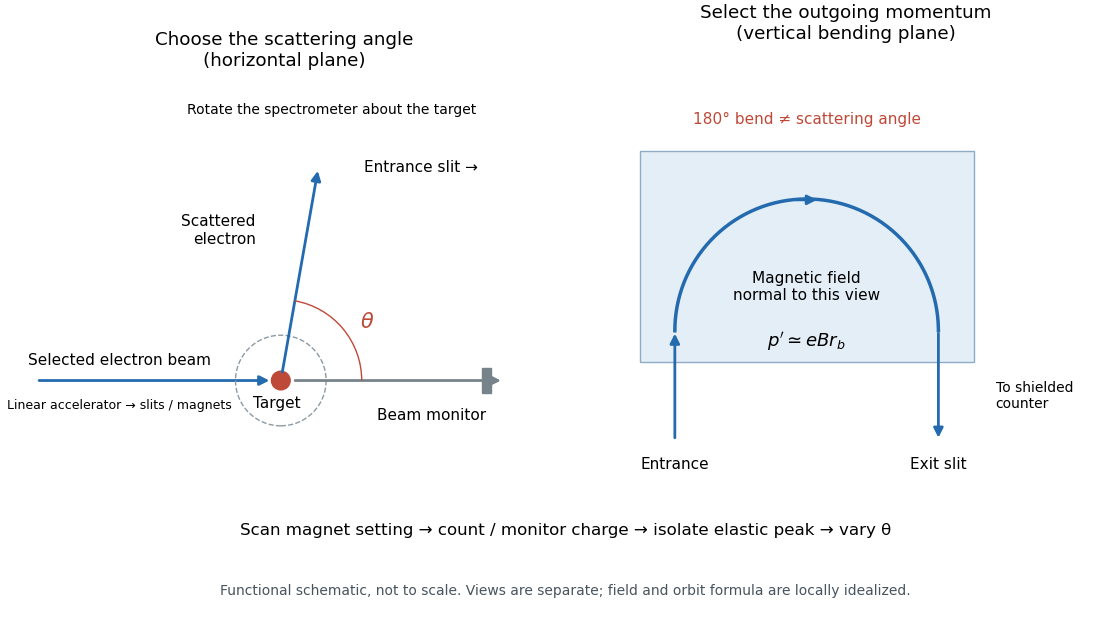
The key distinction is between an electron counter and an energy measurement. Here the counter registers particles admitted by the magnetic spectrometer; changing its magnetic field selects another outgoing momentum. A peak is therefore reconstructed from a scan, rather than read as one pulse whose height equals the scattered electron energy. Dividing counts by monitored incident electric charge compensates for changes in beam intensity. A peak's height alone is insufficient: its area and the instrument's accepted momentum interval determine the selected yield.
An inelastic scattering peak corresponds to a different final nuclear quantum state, so including it in the elastic scattering yield would answer a different structural question. Conversely, finite energy resolution can hide sufficiently nearby excitations beneath an apparent elastic scattering peak. Background subtraction, target-loss corrections, angular acceptance and counter efficiency all enter before counts become a differential scattering cross-section. A dip in uncorrected counts is therefore not automatically a zero of a nuclear charge form factor.
The root mean square radius of a nuclear charge distribution, referred to its center. Define its charge-weighted second moment byFor a spherical charge density with finite fourth moment, insert the Taylor series into the nuclear charge form factor:Thus a radius is a low-momentum transfer slope, not necessarily the position of a sharp edge. In this real static model,The factor of two between the slopes of and matters when interpreting a differential scattering cross-section. A proton charge radius is the corresponding size concept for the proton; the spatial arrangement of many nucleons introduces an additional scale in a heavier atomic nucleus.
In the static charge density model, define the normalized Fourier transformHere is the spatial momentum transfer divided by the reduced Planck constant: has units of inverse length. Physical momentum transfer is . We keep and the speed of light explicit; compute , expressing the numerator in and in , to obtain in inverse femtometres. The spatial is distinct from the invariant four-momentum transfer used in relativistic scattering cross-sections.
For spherical symmetry, take the polar axis along and use spherical coordinates. With the cosine of the polar angle,Every radial shell contributes an amplitude. At all shells add with the same sign; at larger their contributions can cancel. This cancellation is the origin of a diffraction minimum in the nuclear charge form factor, rather than an absence of electric charge in the nucleus.
The static Fourier transform interpretation is appropriate for the nuclear model and kinematic regime specified here. A fully relativistic composite system requires frame and current conventions; its electric form factor is not universally the transform of a frame-independent three-dimensional charge density.
Consider an ideal nuclear charge distribution that is constant inside a ball of radius and zero outside:This is a deliberately sharp-edged model. Substitution into the spherical nuclear charge form factor gives, for ,At take the continuous limit . Direct radial integration gives , and the Taylor series provides an independent check:The first positive zero solves , equivalently , with . Consequently the first diffraction minimum moves toward smaller momentum transfer as increases.
For comparison, a smooth Gaussian function charge density with the same nuclear charge radius isThe Fourier transform of a Gaussian stays positive and has no zero. Both models have the same leading low- curvature, but they disagree at higher momentum transfer: at , the sphere gives and the Gaussian function gives . Measuring only a nuclear charge radius cannot distinguish these two nuclear charge distributions.
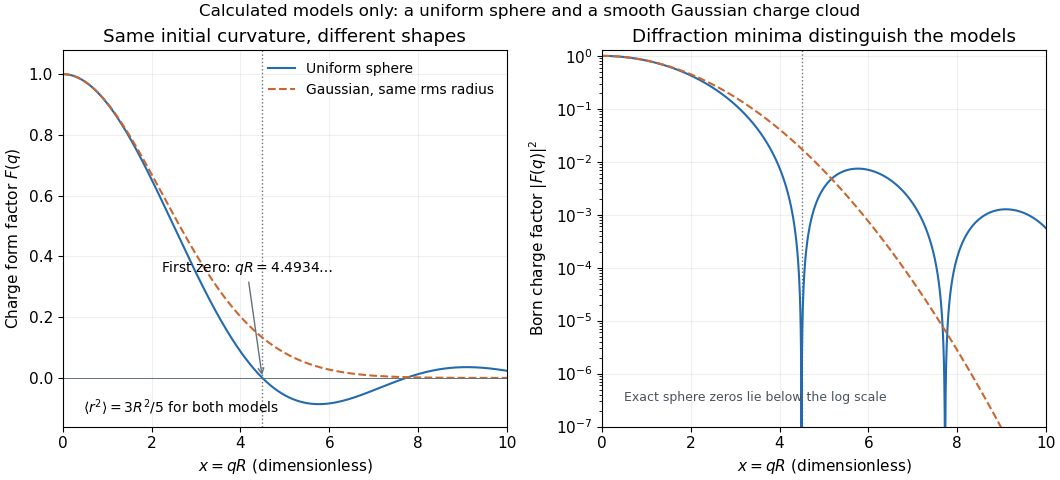
As a chosen scale illustration, take . The predicted first zero is , or using . With a ultrarelativistic electron beam and negligible nuclear recoil, it occurs at . These are consequences of chosen model parameters, not measured properties of carbon or a claim that all atomic nuclei are uniform balls.
For an ultrarelativistic electron scattered elastically by a static, spherical, spin-zero atomic nucleus, a plane-wave Born approximation retains a single electromagnetic interaction. The Fourier transform of its Coulomb potential is proportional to . Relative to the same point charge, the scattering amplitude is therefore multiplied by and the differential scattering cross-section by :Here is the incident total electron energy, the scattering angle, a solid angle element, and the fine-structure constant. The cosine factor already accounts for the projectile's spin; a spinless projectile would give a different point-charge factor. The formula neglects nuclear recoil, electron rest-mass corrections, radiative corrections and Coulomb distortion in electron scattering. The latter can be substantial at large : electron waves then require treatment in the target's Coulomb potential, rather than undistorted plane waves.
Nonzero target spin can introduce magnetic and additional electric contributions, so division by this point-charge expression does not generally isolate one charge form factor for a proton or deuteron. Even for spin zero, finite energy resolution, recoil and Coulomb distortion in electron scattering can change a measured minimum. A zero of the uniform-sphere model is a clear illustration of amplitude cancellation, not a universal prediction of a zero experimental counting rate.
Why should adding one neutron be easy for one atomic nucleus and much less favorable for its neighbor? In the nuclear shell model, nucleons occupy discrete energy levels in a nuclear mean field. Filling all available states below a sufficiently large gap produces a nuclear shell closure. This connects nuclear separation energies with the counting of quantum states, and connects the spin of an odd atomic nucleus with its last unpaired nucleon.
The starting point is an approximate Hamiltonian operatorwhere is a confining potential energy, specifies nuclear spin-orbit splitting, and contains interactions left out of the nuclear mean field. This is an effective organization of the nuclear many-body problem, rather than a derivation of the nuclear force. In a spherical approximation, addition of angular momentum combines the orbital angular momentum with spin to give ; for , only exists.
A level labelled has magnetic substates . The Pauli exclusion principle permits one neutron in each such state and, separately, one proton. Thus a level holds eight neutrons, or eight protons; it does not hold sixteen identical neutrons. Here counts radial levels of the same , starting with the lowest; it is not the hydrogenic principal quantum number. The letters mean .
Promoting a nucleon from an occupied orbital to an unoccupied orbital creates a particle-hole configuration. Its possible angular momenta come from coupling the particle and hole, and its parity relative to the reference configuration is the product of their orbital parities. Residual interactions split and mix configurations; a measured nuclear excitation energy is not generally just an uncorrected independent-orbital spacing.
A missing proton relative to a filled nuclear shell. In a closed-core approximation a single hole in a orbital has the same total angular momentum and orbital parity as the removed particle. For example, removing a proton from a spin-zero closed core gives .
The interaction remaining after a chosen nuclear mean field is subtracted from the nuclear Hamiltonian operator. It can split configurations having the same occupied one-particle levels but different coupled angular momentum. Thus the ordering of nuclear orbitals alone does not determine every odd-odd nucleus ground-state spin.
In the simplest nuclear shell model of an odd-mass number nucleus, paired nucleons contribute zero total angular momentum and magnetic dipole moment. The last unpaired nucleon supplies the nuclear spin and the stretched-state moment , where is the Landé g-factor and the nuclear magneton.
Using addition of angular momentum with givesFor , this reduces to . For , it givesThe free-nucleon orbital factors are for a proton and for a neutron. Residual nuclear interactions and configuration mixing can shift measured moments away from this ideal prediction. A single hole in an otherwise closed shell has the same stretched-state moment as a particle in that shell: removing the particle leaves total and moment .
A nuclear shell groups single-particle energy levels for protons or neutrons in a nuclear mean field. Filling all states below a sufficiently large gap gives a nuclear shell closure. These shells describe quantum-state occupation rather than thin spatial layers. Their discrete filling effects explain departures from the smooth semi-empirical mass formula.
An effective one-nucleon potential energy representing the average influence of the other nucleons. The nuclear shell model treats motion in this field first, then includes residual interactions. The field experienced by a proton also includes the repulsive Coulomb potential; proton and neutron energy levels need not have identical spacings.
A proton number or neutron number associated with a pronounced nuclear shell closure. The traditional sequence isThese count either species separately, rather than their sum . Calling a number magic summarizes a structural pattern; it does not promise that every isotope at that number is equally stable.
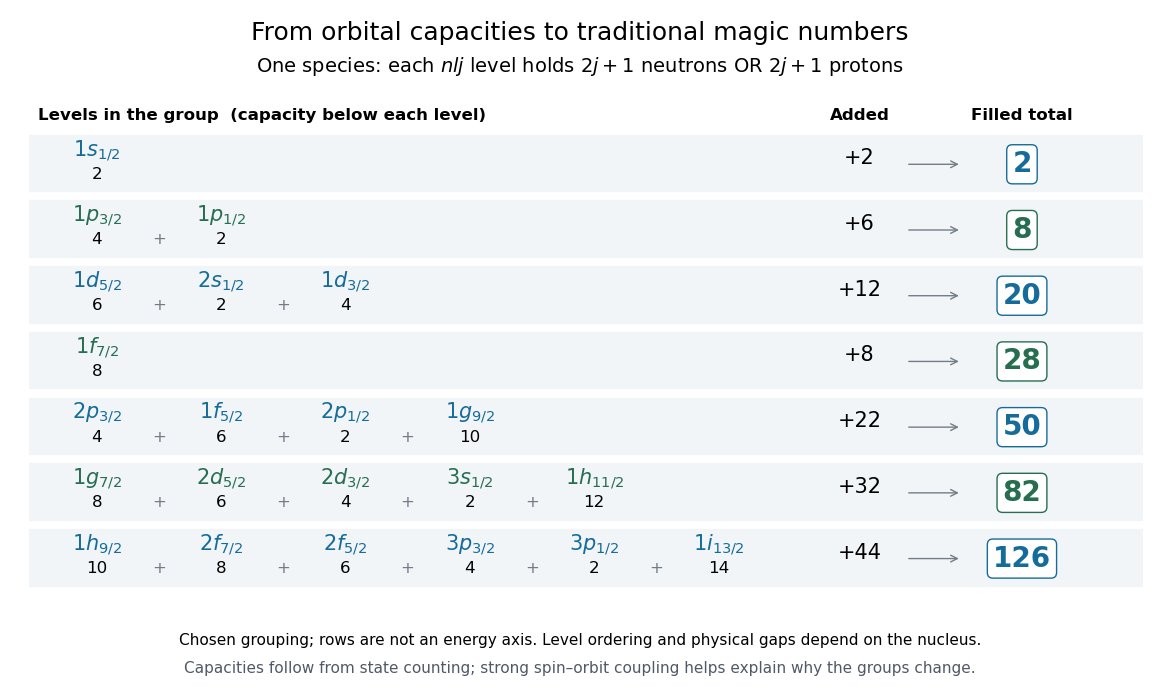
Counting states between traditional nuclear shell closures
. Original capacity diagram for a chosen spherical level scheme. Each orbital contributes states for one species. Rows show groups and cumulative totals, not measured energies or a universal ordering within each group. Details.For example, in the chosen scheme the -particle core plus the eight substates of gives . The next group contributes , giving . The following two groups contribute and , giving and . Counting verifies the capacities once the grouping has been chosen; it does not establish the physical energy gaps that justify that grouping.
Filling the accessible one-species nuclear shell model states below a substantial energy gap. A closed spherical level has all values occupied, so their sum is zero. In the independent-particle picture, a closed core therefore contributes zero total angular momentum; a single particle outside it, or a single missing particle inside it, supplies the leading spin assignment. Residual interactions can change this simple picture.
The three-dimensional isotropic harmonic oscillator alone has one-species shell capacities for oscillator index , including spin. Summing gives closures , rather than the complete traditional magic number sequence. Strong nuclear spin-orbit splitting can separate a high- level from its former neighbors. Realistic radial potential energies and residual interactions also matter: a chosen oscillator plus an arbitrary single constant is not a demonstrated explanation of every real nuclear gap.
Traditional nuclear shell closures can weaken along isotope chains far from stability, as in neutron-rich magnesium.[ref]
Magic numbers disappear and expand area of nuclear deformation by RIKEN. 20 November 2013, magnesium shell weakening
The relevant test is the actual energy gap and the correlated nuclear quantum states, rather than membership in an immutable numerical list.
The splitting of one-nucleon energy levels by their spin-orbit interaction. With , the identity gives, in a state of definite ,The second branch requires . For the illustrative Hamiltonian operator with , the shifts are and . Thus the strong negative coefficient lowers the aligned branch. Its capacity is ; the raised partner holds . Together they still hold identical nucleons: the interaction rearranges states rather than creating them.
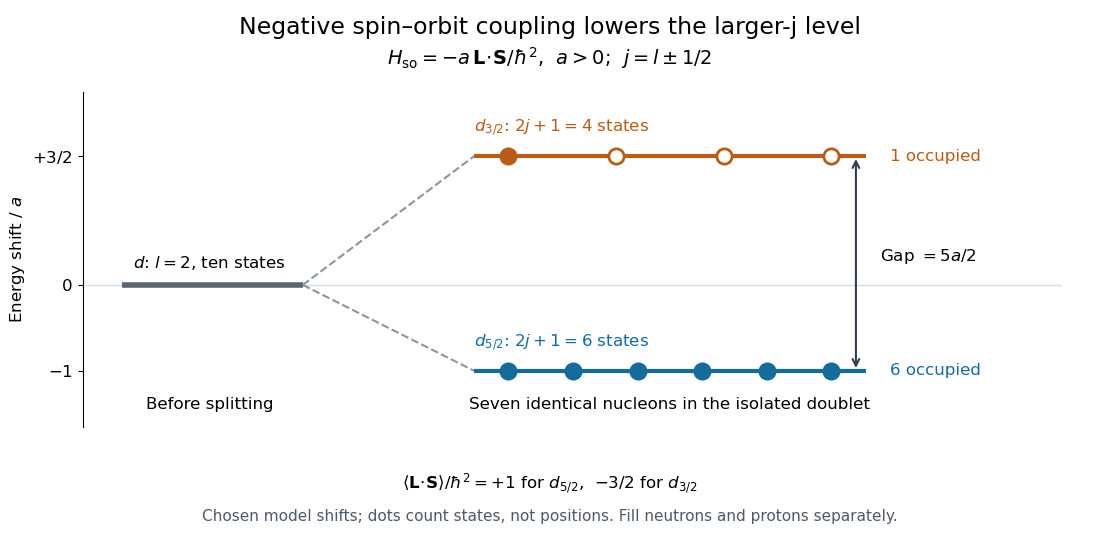
In this example the and shifts are and , respectively, so the gap is . The capacity-weighted mean shift vanishes:This is a useful check on both the sign and state counting. A seventh identical particle cannot occupy another substate of the already full lower level. In a real atomic nucleus, other radial and orbital angular momentum levels can interleave with this doublet, and a radial coupling need not give the same effective for every orbital.
The energy needed to remove specified nucleons from a bound atomic nucleus in its ground state. It compares neighboring nuclear masses, and so can reveal a nuclear shell closure more clearly than a smoothly varying total nuclear binding energy.
With bare nuclear masses, the proton separation energy is the energy needed to remove a proton. A negative value means the daughter plus proton has lower rest energy. Proton emission can still have a finite lifetime because of a Coulomb or centrifugal barrier.
A nuclear drip line marks a boundary beyond which one- or few-nucleon emission becomes energetically allowed. One- and two-particle nuclear separation energies can give distinct boundaries because of nuclear pairing.
The neutron drip line is the neutron-rich boundary at which one- or two-neutron emission becomes energetically possible. Neutrons beyond that boundary are not stably bound; the absence of a Coulomb barrier often makes their emission prompt, subject to angular-momentum barriers.
The proton drip line is the proton-rich boundary at which one- or two-proton emission becomes energetically possible. It is governed by proton separation energies, rather than the energetics of beta decay alone.
Writing positive nuclear binding energy as and nuclear mass as ,The two-neutron nuclear separation energy is . In an independent-particle example, let the last occupied energy level have and the next empty level , for a chosen positive energy unit . With an unchanged core and no residual interactions, removal from the filled level costs , whereas removing the first particle added above it costs : the drop equals the one-particle gap. These are invented model inputs, not measured nuclear values. Nuclear pairing, rearrangement of the nuclear mean field, and correlations complicate that identification in real masses; a finite difference of nuclear binding energies is not automatically a bare one-particle gap.
Correlations that favor pairs of like nucleons coupled to zero total angular momentum in the simplest spherical picture. They help explain why an unpaired nucleon often dominates an odd nucleus's spin, and why neighboring nuclear separation energies show an odd-even staggering. Nuclear pairing belongs to the residual-interaction physics beyond merely filling independent energy levels. Mixing different occupations and deformation can also be necessary; the closed-core picture is most useful near suitable nuclear shell closures.
Isotope abundance, nuclear separation energies, spin and nuclear magnetic moments supply complementary tests: abundance concerns which atomic nuclei survive and accumulate, removal energy concerns binding, and magnetic properties test the angular momentum assignments. Agreement across these observables is more informative than fitting one list of numbers.
In her 1963 lecture, Maria Goeppert Mayer recalled excess abundances at and . She contrasted the strong binding of the last neutron in oxygen isotope with the weaker extra neutron in oxygen isotope , and displayed beta decay energies near and . These are compiled empirical patterns, rather than readings from an apparatus she built.[ref]
Her 1949 letter compared observed spins and nuclear magnetic moments with orbital assignments. For example, lead isotope was assigned a neutron hole near , whereas bismuth's odd proton began the next shell as . The moments tested orbital character as well as spin.[ref]
On Closed Shells in Nuclei. II by Maria Goeppert Mayer. p. 1970, discussion and Table II
A useful comparison holds fixed when comparing neighboring isotopes, and examines odd-even staggering separately from a shell discontinuity. Abundance additionally depends on production and decay history. Neither the abundance pattern nor a successful spin assignment directly images orbiting particles; neither fixes a unique nuclear mean field. The experimental techniques themselves include mass spectrometry and nuclear magnetic resonance, whose preparation and readout differ. The Hofstadter nuclear electron scattering experiment separately constrains nuclear size and nuclear charge distributions, rather than measuring these occupancies.
A 2013 RIKEN experiment used a fast calcium beam on beryllium, selected radioactive aluminium and silicon fragments, then struck carbon to produce magnesium isotopes with . Emitted gamma rays supplied excitation energies; comparison across these isotopes supported deformation extending beyond the region toward . This tests the limits of traditional magic numbers, not merely their arithmetic. The inferred shape depends on nuclear-structure interpretation of the energy levels, rather than direct imaging.[ref]
Magic numbers disappear and expand area of nuclear deformation by RIKEN. 20 November 2013, beam preparation, gamma-ray readout and deformation inference
The 1948 empirical synthesis preceded the 1949 strong spin-orbit interaction proposals. Johannes Hans Daniel Jensen recalled developing that idea in a discussion with colleagues, independently of Maria Goeppert Mayer's work; their shared problem was to account for the observed magic numbers and spins.[ref]
Glimpses at the History of the Nuclear Structure Theory by Johannes Hans Daniel Jensen. pp. 46–48, empirical evidence and strong spin-orbit proposal
Johannes Hans Daniel Jensen emphasized that even nuclear ground states retain correlations and that independent-particle motion becomes less adequate at higher excitation. This helps explain why the nuclear shell model needs residual interactions and complementary collective descriptions.[ref]
Glimpses at the History of the Nuclear Structure Theory by Johannes Hans Daniel Jensen. pp. 48–49, correlations and configuration mixing
The 1963 Nobel Prize in Physics recognized Maria Goeppert Mayer and Johannes Hans Daniel Jensen for nuclear shell structure. Eugene Paul Wigner's share recognized his contributions to nuclear and elementary-particle theory, especially fundamental symmetry principles, a distinct award motivation.[ref]
All Nobel Prizes by Nobel Prize Outreach. 1963 Physics: separate motivations for Wigner and for Goeppert Mayer and Jensen
A description of an atomic nucleus in terms of coordinated motion of many nucleons, especially changes in shape and orientation. The nuclear shell model organizes individual nucleon states in a nuclear mean field; the collective nuclear model organizes low-lying energy levels by nuclear deformation, nuclear rotational bands and nuclear quadrupole vibrations. These are complementary organizations of the same nuclear many-body problem. A deformed nuclear mean field can support individual-particle states while its orientation supplies a slow collective coordinate.
In his 1975 lecture, Ben Roy Mottelson described coupling individual-particle motion to nuclear shape coordinates, and distinguished observed rotational spectra from vibrations about spherical equilibrium. This connects the two descriptions without treating the collective coordinates as extra constituent particles.[ref]
Elementary Modes of Excitation in the Nucleus by Ben Roy Mottelson. pp. 236–237, coupled Hamiltonian and interpretation of low-energy excitation spectra
James Rainwater's 1975 account identifies unexpectedly large electric quadrupole moments as a motivation for a deformable nuclear mean field. The challenge concerned their magnitude, even where spherical-shell trends had the correct sign.[ref]
Background for the Spheroidal Nuclear Model Proposal by James Rainwater. p. 264, Fig. 3 and discussion of the 1949 quadrupole compilation
A simple original potential energy example makes the coupling tangible. Let be a dimensionless signed shape coordinate for a chosen intrinsic configuration, its restoring stiffness, and a configuration-dependent coupling, both with units of energy. SupposeThe minimum is , with energy gain . For chosen values and , where is an arbitrary positive energy unit, and the gain is . This illustrates how a configuration can favor deformation when the core can respond. It is not a fitted nuclear surface or a claim that every configuration chooses the same shape; competing configurations and nuclear pairing can favor a spherical minimum.
The predictive attraction is economy: one collective scale relates several energy levels, while electric quadrupole transitions independently test their common structure. Agreement in both is much more restrictive than assigning a separate free parameter to every level. Nuclear magnetic moments test magnetic structure and angular momentum assignments; they are distinct observables from the electric quadrupole moments used to infer charge deformation.
A collective oscillation of the quadrupole shape coordinates of an atomic nucleus. Near spherical equilibrium, the ideal harmonic description has five components, corresponding to the five magnetic substates of angular momentum two. Each quantum carries ; it is an excitation of the many-nucleon system rather than an extra constituent. Its frequency is , and its energy spacing follows the quantum harmonic oscillator.
One quantum produces a level at . Two identical quadrupole quanta can couple to in a symmetric state, giving a degenerate multiplet at in the ideal model. Odd total would be antisymmetric under their exchange. Thus the first to first excitation ratio is , rather than the nuclear rotational band value . Real nuclear quadrupole vibrations can be anharmonic and their multiplets split: the ratio is a diagnostic of a limiting model, not a universal classification rule.
There is a useful state-counting check. Two identical quanta distributed among five substates span symmetric states. The proposed multiplet contains . This verifies the angular-state bookkeeping independently of the chosen energy scale.
Three identical quadrupole quanta occupy the third symmetric power of the five-dimensional spin-two space. Its dimension is , and its irreducible representations have , each once. All have positive parity. This counts allowed angular states in the ideal harmonic nuclear quadrupole vibration; anharmonic interactions can split their energies.
Excitation of an atomic nucleus by the electric field of a passing charged projectile. For suitable collision energies and separations, the electromagnetic interaction can populate collective states without requiring contact through the nuclear force. Electric quadrupole transition strengths connect excitation yields with collective charge motion; inferring a shape additionally assumes a nuclear model. Contributions from the nuclear force, competing transitions and the collision kinematics must be controlled before identifying a yield with a single quadrupole strength.
In the straight-trajectory dipole model, retain the Coulomb-coupling convention of . In SI units the coupling denoted here is . First-order time-dependent perturbation theory expresses a transition through the Fourier transform of this pulse at the transition angular frequency.
For positive put . The two Cartesian pulse transforms arewhere is a Modified Bessel function of the second kind. One may derive these from the Fourier transform of , differentiating in its scale and integrating its spatial derivative by parts. For , while , so the transverse impulse gives the probability in the title. If the matrix element vanishes, the smaller longitudinal term can be the leading nonzero contribution.
The conditions include large compared with the atomic extent for the electric-dipole approximation, a small total transition probability for first-order theory, and a collision time short compared with . Large instead gives exponentially suppressed excitation in this model through the large-argument behavior of .
An atomic nucleus with even proton number and even neutron number . The simple nuclear pairing picture couples the constituent pairs to zero angular momentum. The collective examples below concern a ground state, where the superscript denotes positive parity, and its associated low-lying excitations; even alone would also allow odd and odd .
Departure of an intrinsic nuclear shape from spherical symmetry. Here intrinsic means referred to axes attached to a model nuclear charge distribution. A nuclear quantum state with definite spin need not have the same laboratory charge density as that intrinsic distribution. In particular, the ground state of a deformed even-even nucleus can have , a spherical laboratory expectation value, and a nonzero intrinsic nuclear quadrupole moment.
For an illustrative uniform charge density inside a spheroid, let the semiaxes be and keep its volume equal to that of a sphere of radius :Thus gives a prolate spheroid, a sphere, and an oblate spheroid. These are three-dimensional equal-volume shapes: equal areas of their drawn cross-sections would be a different constraint. Real nuclear charge distributions have diffuse surfaces and need not be uniform, axially symmetric or confined to one shape.
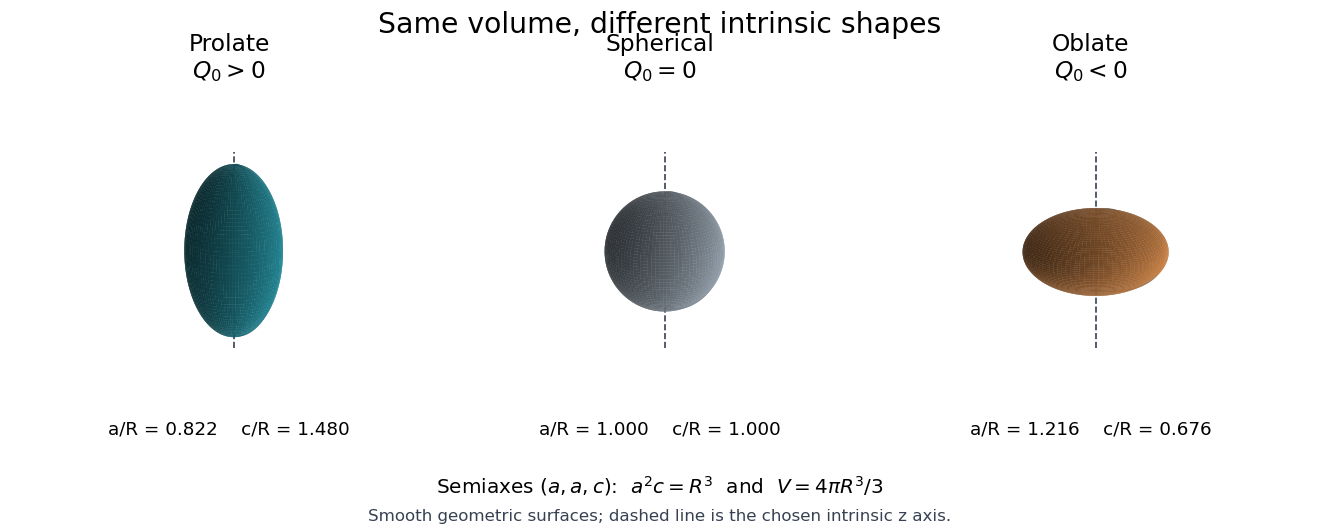
The axial electric quadrupole moment of an intrinsic nuclear charge distribution, with the origin at its center and the axis along its symmetry axis:This convention includes electric charge in ; a tabulated moment divided by the elementary charge instead has units of area. For the uniform spheroid, mapping a uniform unit ball to gives and , soThe formula explains the signs in the figure. It measures an anisotropy of the nuclear charge distribution, rather than counting individual nucleons on a surface. An illustrative choice gives , and , while preserving exactly.
James Rainwater's lecture contrasts measured laboratory electric quadrupole moments with intrinsic moments inferred through Coulomb excitation, including even-even nuclei. Extracting intrinsic shape therefore uses a nuclear model, rather than equating every measured moment to .[ref]
Background for the Spheroidal Nuclear Model Proposal by James Rainwater. p. 266, Fig. 4 and preceding Coulomb-excitation discussion
The laboratory expectation value of the axial electric quadrupole moment in the stretched nuclear quantum state ; is the laboratory component of total angular momentum. It differs from the intrinsic nuclear quadrupole moment . In an axial nuclear rotational band with , projection onto definite angular momentum givesHere denotes the component of total angular momentum along the intrinsic symmetry axis. Consequently a positive for a prolate spheroid corresponds to a negative in this model. The sign of the laboratory moment alone must be interpreted together with the band assignment.
The result has a short symmetry explanation. A spin-zero state has no preferred spatial direction. Its second charge moments satisfy , so . Equivalently, averaging an intrinsic axis uniformly over directions gives , where is a Legendre polynomial. This is a statement about a quantum expectation value, not a classical picture of a spinning object sweeping through orientations.
For an independent check of the sign, the , rotor orientation probability is proportional to , using a spherical harmonic. With ,A zero static laboratory moment does not make every quadrupole observable zero. With electric multipole operator , define the reduced transition strength using a reduced matrix element:In the axial rotor, angular projection gives and . The factor of five is the ratio of the numbers of magnetic substates. Thus an electric quadrupole transition can reveal collective deformation even when . These strengths determine within the model; their squares alone cannot distinguish its sign.
A sequence of nuclear energy levels interpreted as different total angular momenta built on approximately the same intrinsic structure. For an axially symmetric, positive-parity, ground state band of an even-even nucleus, the allowed sequence is . The simple constant-inertia rotor hasHere is an effective moment of inertia, and the reduced Planck constant. The even- restriction belongs to this particular intrinsic symmetry and band, rather than to all nuclear excitations. The angular momentum operator eigenvalue supplies , rather than the classical replacement .
Set . Since , the model predictsFor a chosen model scale , the excitation energies are . The corresponding successive gamma ray energies are approximately , neglecting nuclear recoil. Level energies and emitted line energies are different lists. These numbers illustrate the formula and are not a measured isotope spectrum.
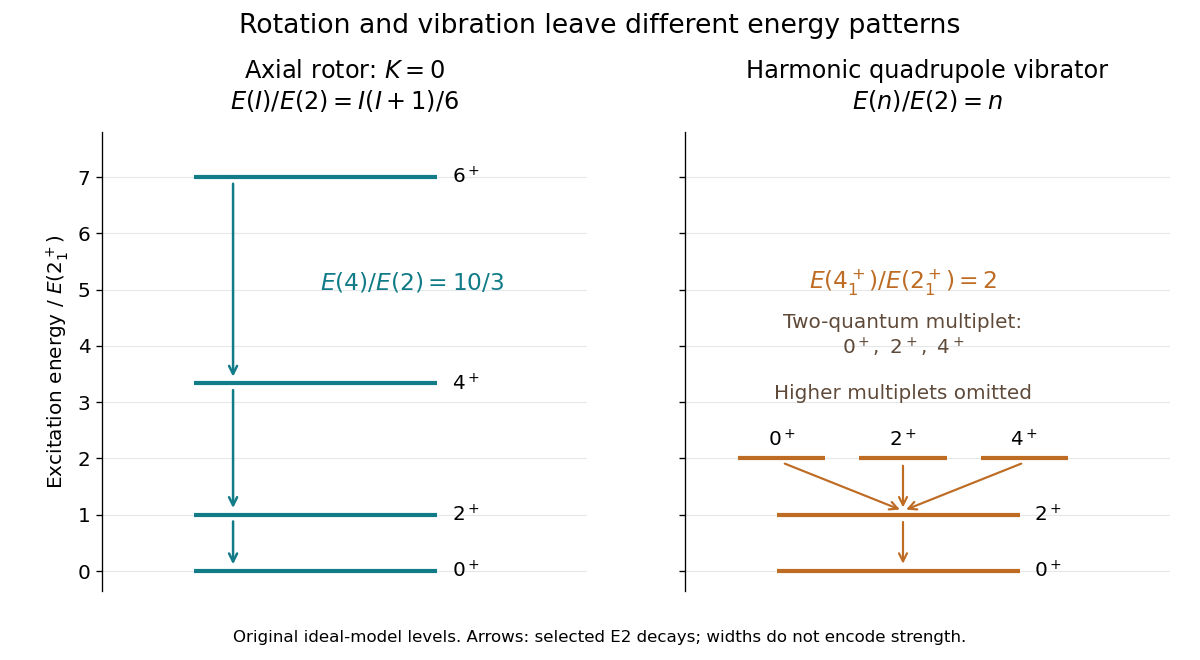
The fitted is a response parameter, not automatically the moment of inertia of a classical rigid charge distribution. Nuclear pairing changes this response; Ben Roy Mottelson connected observed inertias with correlations beyond independent-particle motion.[ref]
Elementary Modes of Excitation in the Nucleus by Ben Roy Mottelson. continuation after p. 237, pairing correlations and Fig. 1 potential-energy surfaces
At larger angular momentum, changing intrinsic structure or nuclear pairing can invalidate a single constant . A useful diagnostic is to compare across several levels: constancy tests the simple formula, while a drift identifies the need for additional physics. A successful ratio alone neither specifies every microscopic motion nor measures a literal solid-body rotation.
The excitation energy in an ideal nuclear rotational band determines an effective moment of inertia through the displayed equation. Comparing it with tests the rigid-sphere scale. A sequence of approximately constant supports the rotational interpretation; systematic variation indicates that the effective inertia changes along the band. Collective rotation need not have a rigid-body inertia, notably when nuclear pairing is important.
Aage Niels Bohr's 1975 lecture presents a plutonium spectrum deduced from the fine structure of alpha decay of curium . The readout was decay-line energy; the comparison fixed the rotor scale from the first excitation and tested the remaining levels against . The lecture reports spectroscopy, rather than a laboratory setup operated by its author.[ref]
Rotational Motion in Nuclei by Aage Niels Bohr. p. 217, Fig. 3 caption, plutonium spectrum and one-scale comparison
His measured erbium band has excitation energies , , , and for . The same lecture analyzes interband electric quadrupole transitions, adding tests beyond level positions.[ref]
Rotational Motion in Nuclei by Aage Niels Bohr. p. 225, Fig. 9 measured levels and following discussion of Fig. 10 transition matrix elements
Using those first two excitations gives , close to the ideal , and distinct from the ideal harmonic value . Fixing the rotor scale with predicts at and at . The measured values lie about and below these predictions. This is a useful limit of the simple model: the pattern supports a rotational interpretation while revealing departures from constant inertia. It does not by itself determine a unique nuclear charge distribution. Reconstructing a level scheme also requires assigning which transitions connect which states; raw peak positions alone do not provide all spins, parities or transition strengths.
Articles by others on the same topic

The atomic nucleus is the small, dense region at the center of an atom that contains most of the atom's mass. It is composed of two types of subatomic particles: protons and neutrons. - **Protons** are positively charged particles, and their number determines the atomic number of an element, which defines the element itself (e.g., hydrogen has one proton, while carbon has six). - **Neutrons** are neutral particles, meaning they have no charge.