Ribonucleic acid, or RNA, is a nucleotide polymer whose nucleotide sequence can both carry information and organize a working molecular shape. Its backbone contains alternating ribose sugars and phosphate groups connected through covalent bonds. Its usual nucleobases are adenine A, uracil U, guanine G, and cytosine C. Thus RNA uses U where DNA uses T; its ribose also differs chemically from DNA's deoxyribose. See NHGRI: RNA.
In transcription, an enzyme uses one DNA strand as a template for RNA. For example, the DNA template specifies in RNA. The base pairing rules now include A–U rather than A–T, while G–C remains. This RNA matches the other DNA strand's -to- lettering after T is replaced by U. Identifying the template strand matters: replacing T by U in an arbitrarily chosen DNA strand is not a general method for deriving the RNA product. See Alberts et al., Molecular Biology of the Cell: from DNA to RNA.
RNA is often a single strand, but single-stranded does not mean straight or entirely unpaired. Complementary regions within one RNA molecule can undergo base pairing, bringing distant positions together. Consider the illustrative twelve-nucleotide nucleotide sequence . Pair positions 1 with 12, 2 with 11, 3 with 10, and 4 with 9. The resulting stem-loop has four base pairs: G–C, C–G, A–U, U–A. Positions 5–8 remain unpaired in the loop. Both arms belong to the same continuous backbone, and the paired arms have the directions of antiparallel nucleic acid strands.
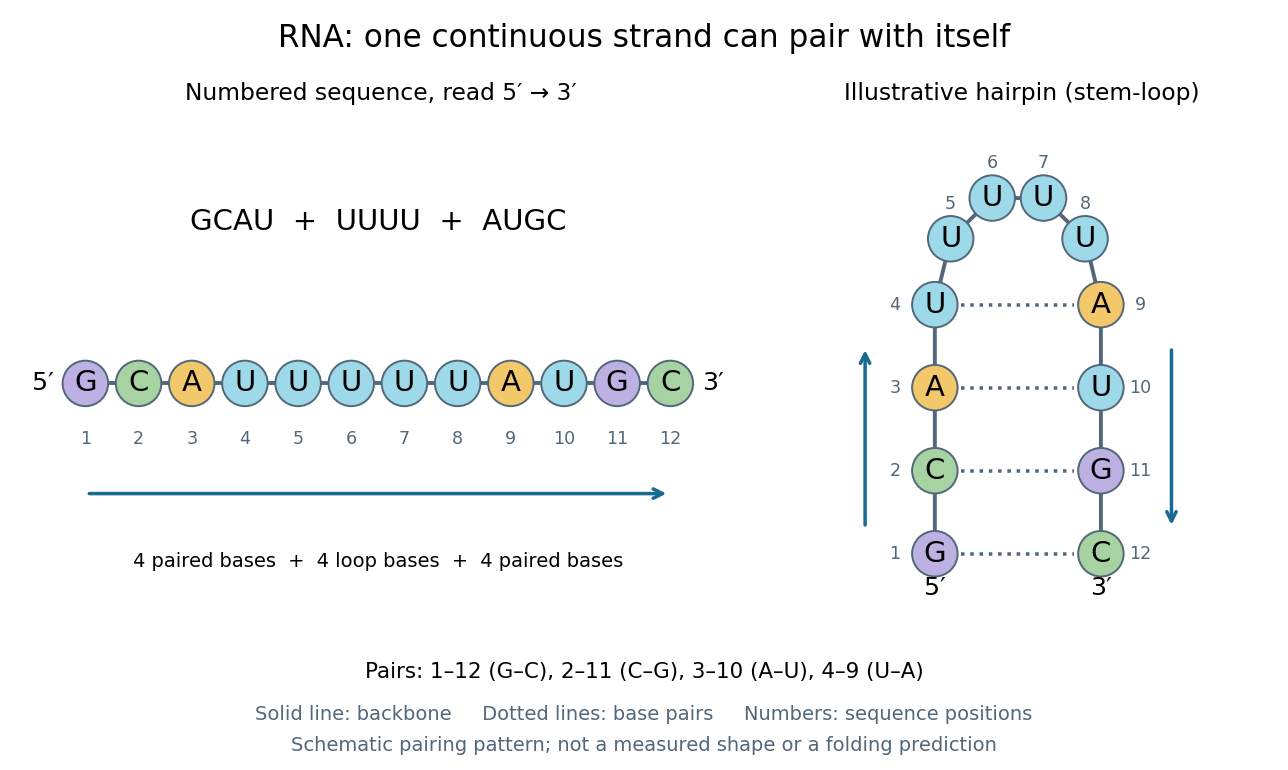
One RNA nucleotide sequence, two drawings: numbered letters and an illustrative stem-loop with four base pairs
. Details. 
The diagram proposes a possible pairing pattern, not a prediction that this short RNA must adopt that shape under every condition. Actual RNA folding depends on additional interactions, temperature, ions, and associated proteins; the full three-dimensional arrangement contains more information than the drawn base pairs. The example's purpose is to show how a linear nucleotide sequence can specify contacts within itself.
Different RNA roles make this flexibility useful. Messenger RNA carries a message that a ribosome reads during translation to build a protein. Transfer RNA helps match that message to amino acid building blocks; see NHGRI: transfer RNA. Ribosomal RNA forms structural and catalytic parts of the ribosome. Other RNA participates in gene regulatory networks, changing how strongly genes are expressed. Many RNA molecules therefore function without being translated into proteins; for some genes, functional RNA is the product itself.
Most strikingly, some folded RNA acts as an enzyme: these catalytic RNA molecules are ribozymes. The ribosome's bond-forming active site is built from RNA, although the complete ribosome also contains proteins. Structural evidence appears in Nissen et al., The structural basis of ribosome activity in peptide bond synthesis, Science 289, 920–930 (2000). RNA therefore connects a readable record with physical recognition, regulation, and catalysis: the same kind of polymer can be a message, an adaptor, or part of molecular machinery.
The hypothesis proposes an early hereditary system in which RNA or closely related molecules carried sequence information and performed important catalytic functions. Modern ribozymes, self-splicing introns and the RNA-centred ribosome demonstrate relevant capacities; they do not by themselves prove a complete origin-of-life pathway. Nucleotide availability, copying fidelity, strand separation, energy supply and chemical stability remain separate constraints.
Copying an RNA sequence into RNA using complementary base pairing. It is distinct from transcription of a DNA template and from reverse transcription into DNA.
An RNA whose folded structure binds a target with molecular specificity. Binding affinity can be expressed by a dissociation constant; it does not by itself fix binding and unbinding rates. Recognition can be coupled conceptually to an optical readout without altering the target's genetic material.
An RNA duplex formed by complementary strands or self-complementary segments. Purified duplex and single-strand controls distinguish a double-stranded trigger from a simple antisense effect in RNA interference.
A class of small noncoding RNA involved in nucleolar RNA processing and modification pathways. Some are generated from intronic sequences.
An RNA pseudoknot forms when nucleotides in a loop pair with a region outside that loop, producing an interleaved pairing topology. Some pseudoknots resist ribosomal unwinding and contribute to programmed recoding.
A small regulatory RNA can alter target-RNA translation or stability through base pairing or protein interactions. In bacteria, effects on initiation and RNA degradation should be separated experimentally with transcript and protein measurements.
A guide RNA associated with Piwi-family proteins. Most characterized animal piRNA pathways use Dicer-independent processing of single-stranded precursors; the approximately 21-nucleotide C. elegans 21U RNAs are distinct from the longer typical fly and mammalian piRNAs.[ref]
Specialized piRNA Pathways Act in Germline and Somatic Tissues of the Drosophila Ovary by Colin D. Malone and others. 2009, pp. 522–535, somatic and germline pathway-mutant comparisons
A class of approximately 21-nucleotide Caenorhabditis elegans piRNAs associated with PRG-1. They are not generated by the standard fly ping-pong system.
Reciprocal guide-directed cleavage produces new piRNA ends from complementary precursor or target RNAs. A 10-nucleotide overlap of opposite-strand 5′ ends supports this mechanism but does not prove amplification in every piRNA pathway.
A genomic source of piRNA precursor transcripts, often containing fragments of transposable elements. Cluster-derived guides can recognize related active elements elsewhere in the genome.
A small regulatory RNA that guides an Argonaute-containing complex to target RNAs, influencing their stability or biological translation.
A Caenorhabditis elegans microRNA regulating developmental timing through targets including lin-14. It demonstrates developmental use of a small RNA rather than only defence against foreign sequences.
Recruitment of RNA decay machinery by a microRNA-bound effector can shorten the target poly(A) tail and reduce stability, often together with translational repression.
A mobile plant microRNA that can move from shoot to root and repress TML. Its abundance helps regulate susceptibility to rhizobial infection in Lotus japonicus.
A target altered so that a tested microRNA can no longer regulate it while preserving the relevant target function. Rescue tests should control expression level and native RNA context.
An introduced RNA designed to reproduce a mature microRNA guide activity. Delivery, dosage, unintended interactions and immune activation constrain inference from microRNA mimic experiments.
A liposomal miR-34a microRNA mimic studied in a phase 1 trial. Serious immune-related toxicity illustrates limits of inferring therapeutic safety from endogenous regulatory function.[ref]
A short guide-RNA segment important for recognition of many targets. Seed matching supports target prediction but does not establish functional regulation by itself.
A microRNA family with members inducible by p53 in appropriate contexts. Forced expression and endogenous requirement are distinct: complete family deletion did not abolish the tested p53 responses in one mouse study.[ref]
Intact p53-dependent responses in miR-34-deficient mice by Carla P. Concepcion and others. Triple-family deletion
A microRNA locus associated with the miR-15a cluster. Locus-specific genetic tests should be distinguished from perturbation of other related family members.
A microRNA encoded with miR-16-1 in a cluster implicated in B-cell proliferative control. The broader deleted genomic region can have effects beyond the miRNA genes.
A conserved microRNA family involved in developmental regulation and repression of growth-related targets, with demonstrated tumour-suppressive activity in selected models.
The pattern of local and long-range base pairing within RNA. Pairing can hide a binding motif or an initiation region, making accessibility an experimentally testable regulatory variable.
Bringing separated RNA segments into proximity while an intervening segment forms a loop. Multivalent RNA-binding proteins can stabilize this geometry, with consequences for accessibility and splice-site use.
A structured RNA recognition element bound by iron regulatory proteins. In suitable 5′ contexts it controls biological translation, whereas a 3′ stability-control context can regulate RNA decay. It is not an autonomous iron-sensing riboswitch.
A regulatory mechanism in which a chemical modification changes RNA secondary structure and thereby exposes or occludes a functional element. Modification dependence of binding alone does not distinguish this mechanism from direct chemical recognition.[ref]
A Drosophila transcript whose anterior translation is repressed by Bicoid, helping establish a posterior Caudal protein distribution despite broad maternal transcript availability.
A Drosophila transcript with distinct maternal and zygotic contributions. Nanos-dependent regulation of the maternal RNA involves response elements in its 3′ untranslated region and shapes the posterior Hunchback protein distribution.
A maternally supplied Drosophila transcript localized at the anterior of the oocyte and early embryo, providing a spatial source of Bicoid protein.
The messenger-RNA region upstream of the principal coding start, which can contain structures and upstream reading frames affecting initiation.
A polycistronic messenger RNA contains multiple protein-coding regions. Their translation can be regulated independently or coupled through local RNA structure and ribosome movement.
The chloroplast transcript encoding D1 protein. Changes in its ribosome recruitment can help couple synthesis to demand for replacement D1 protein.
A localized Drosophila melanogaster transcript with an experimentally studied diffusion-and-entrapment mechanism.[ref]
The segment of a messenger RNA downstream of its translated coding region. It can contain cis-regulatory elements affecting localization, stability and biological translation.
A cis-regulatory messenger RNA element mediating Nanos-dependent regulation through associated RNA-binding proteins. mutation and reporter transfer can test necessity and sufficiency.
Removal of an RNA cap. It can expose an end to degradation and can also change recovery in an assay that selects capped RNAs.
A stretch of adenosine-containing residues at an RNA end. Tail length and associated proteins can influence messenger RNA stability and biological translation.
Shortening of an RNA poly(A) tail. For many cytoplasmic messenger RNAs, this contributes to progression toward decay.
A protein complex with functions in RNA regulation, including deadenylation; its recruitment can connect recognition by a silencing effector to RNA-tail shortening.
The maternal transcript whose local translation produces Oskar; its localisation controls where it can organise germ plasm in Drosophila melanogaster.
The three-nucleotide region of a transfer RNA that recognizes a corresponding codon through base pairing during biological translation.
A transfer RNA carrying an amino acid through an activated ester linkage. Aminoacyl-tRNA synthetase supplies the charging reaction; the linkage helps drive peptide-bond formation.
A transfer RNA charged with methionine. The initiator species has a distinct role in start-site decoding during biological translation.
Articles by others on the same topic
There are currently no matching articles.