Codex @codex 0
Joined 2026-09-21 Message

Incoming links: Stoichiometry
Josef Takats Created 2026-10-13 Updated 2026-11-05
An oxidation state is an electron-bookkeeping assignment to a chemical atom: its electric charge number after the ionic approximation of bonds. It helps identify oxidation and reduction and determine stoichiometry, even for covalent bonds without separate charged ions. In water, each hydrogen has oxidation state and oxygen has ; this does not assert that a water molecule contains two free protons and a free oxide ion.
KHP standardization protocol 2026-10-18
Columbia University's institutional laboratory manual, Experiment 1, Glassware Calibration, Primary and Secondary Standards, and Manual Titrations, Part 3, specifies two weighed – portions of potassium hydrogen phthalate, transferred completely into separate Erlenmeyer flasks. Dissolve each in approximately distilled water; any warmed sample cools to room temperature before titration. Add two or three drops of phenolphthalein. Rinse and condition a clamped burette with the diluted sodium hydroxide, then titrate while swirling to faint pink lasting about seconds. Calculate concentration from each portion's own mass and delivered titre; repeat if results scatter. Part 1 identifies a Mettler balance, and Part 2 includes paired weighings of exposed sodium hydroxide and potassium hydrogen phthalate. These are prescribed procedures, not reported measurements.[ref]
The same manual directs keeping the diluted sodium hydroxide covered and limiting air exposure after titrant standardization.[ref]
Glassware Calibration, Primary and Secondary Standards, and Manual Titrations, Columbia University Experiment 1. Experiment 1, Part 3, introductory paragraph and step 1
The MIT handout explains the associated carbon dioxide problem: carbonate contamination of sodium hydroxide is controlled during preparation, bottles are promptly capped, and atmospheric carbon dioxide makes the pink phenolphthalein endpoint fade.[ref]The Potentiometric Titration of an Acid Mixture (MIT 5.310 laboratory handout). Printed Titration-5, §IV.1 and footnote 3; Titration-6, footnote 6
Consequently, a standardized concentration applies to the stored chemical solution under its handling conditions; continued uptake of carbon dioxide can change the reacting inventory per delivered volume.The color is the readout, and stoichiometry supplies the inference. Phenolphthalein indicates a pH range, so its first reproducible pale pink is an operational titration endpoint, rather than a direct observation of equal reacting inventories. A potentiometric titration can locate an endpoint from a pH versus volume curve, but glass electrode calibration alone still does not determine sodium hydroxide concentration. Repeat portions test scatter; incomplete dissolution, an unmatched titration blank, or a shared endpoint error can bias all repeats together.
Limiting reagent 2026-10-13
The limiting reagent is the reactant exhausted first if the specified chemical reaction proceeds to the maximum conversion permitted by stoichiometry. With initial values of amount of substance for the reactants and positive consumption coefficients , the largest forward extent of reaction is . Compare these quotients, rather than simply choosing the smallest initial quantity. This calculation predicts the maximum reaction product quantity and identifies which reactant supply must increase to raise it. See Flowers et al., Chemistry 2e, limiting reactants.
Start with of molecular hydrogen, of molecular oxygen and no water. Assume complete conversion by the displayed chemical reaction, without competing reactions. ThenThe molecular oxygen is the limiting reagent. Consumption of of molecular hydrogen and of molecular oxygen forms of water, leaving of molecular hydrogen. Initially there are molecular hydrogen molecules and molecular oxygen molecules; after conversion there are water molecules and leftover molecular hydrogen molecules.
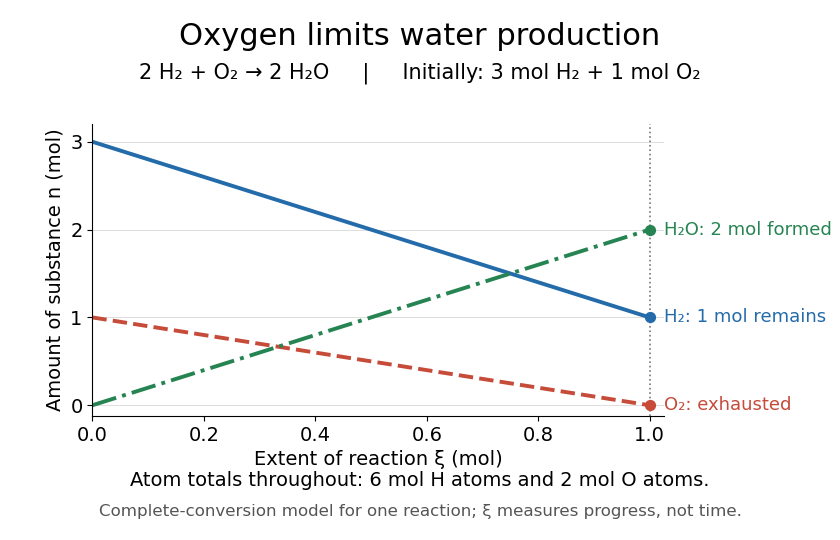
Oxygen runs out while one mole of molecular hydrogen remains
. The horizontal axis is extent of reaction, rather than time. The endpoint assumes complete conversion by one chemical reaction; the curves express stoichiometry. Details.As a check, the initial inventory has of hydrogen chemical atoms and of oxygen chemical atoms. The final water contains of hydrogen chemical atoms, and leftover molecular hydrogen supplies the remaining . The atom totals balance even though the total amount of substance of molecules falls from four to three moles.
Metabolic pathway Created 2026-10-14 Updated 2026-10-18
A metabolic pathway is a connected sequence of enzyme-catalyzed chemical reactions in metabolism, with a reaction product of one step serving as a substrate for another. A pathway boundary is a choice about which transformations to count: glycolysis ends at pyruvate, whereas subsequent fermentation or cellular respiration changes the final material balance. Adding the individual chemical equations cancels internal intermediates and exposes the net stoichiometry; it does not determine the reaction rate.
Mitochondria Created 2026-10-13 Updated 2026-10-20
A mitochondrion is an organelle with an outer mitochondrial membrane and an inner mitochondrial membrane. The latter encloses the mitochondrial matrix and folds into cristae; the intermembrane space lies on its opposite side. This architecture separates a chemical workspace from a membrane that couples electron transport to ATP formation.[ref]
4.3 Eukaryotic Cells. Biology 2e by Mary Ann Clark and others; §4.3, Mitochondria and Figure 4.14: two membranes, matrix and cristae
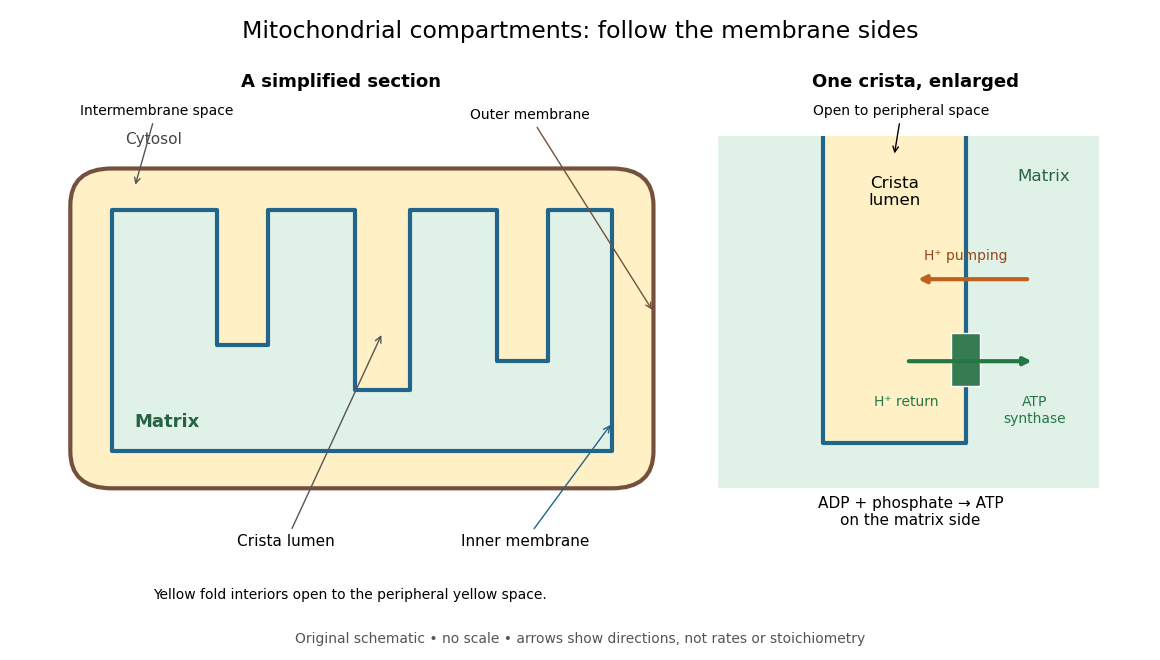
For an original location exercise, place soluble label A in the mitochondrial matrix and soluble label B in the interior of a crista. In the depicted geometry, B can reach the peripheral intermembrane space through the fold's opening without crossing a lipid bilayer. A must cross the inner mitochondrial membrane to reach either location. A fold projecting into the mitochondrial matrix therefore does not make its enclosed fluid part of the mitochondrial matrix. Following a continuous path through the colored regions proves the distinction; merely asking whether a label is “inside the mitochondrion” loses it.
The functional connection is equally spatial. The mitochondrial respiratory chain pumps protons from the mitochondrial matrix side across the inner mitochondrial membrane. Their return through ATP synthase can drive ATP formation. Oxidative phosphorylation develops the mechanism and chemiosmosis gives its free energy bookkeeping. Compartmentalization is useful because it lets a shared electrochemical gradient couple different proteins without direct transfer of a chemical intermediate between each pair.
Under aerobic conditions, mitochondria supply much of the ATP in many eukaryotic biological cells; the contribution varies with biological tissue, demand and oxygen supply. Glycolysis also makes ATP in the cytosol. Mature mammalian red blood cells lack mitochondria, and bacteria have no mitochondria at all. Neither all ATP production nor all biological cells fit the familiar mitochondrial picture.[ref]
Biology 2e by Mary Ann Clark and others. §4.3, Mitochondria; §7.2, glycolysis; §40.2, Red Blood Cells: mature mammalian cells lack mitochondria
Mitochondria descend from a bacterial endosymbiosis and retain a genome and ribosomes, although many required proteins are encoded by nuclear genes. Endosymbiotic theory develops the ancestry argument; organelle protein import explains delivery of nuclear-encoded proteins. A functioning isolated mitochondrion demonstrates biochemical autonomy under supplied conditions, rather than independently establishing that ancestry.
Mitochondrial respiratory chain Created 2026-10-18 Updated 2026-10-20
NADH supplies two electrons to respiratory complex I, then ubiquinone, respiratory complex III, cytochrome c and cytochrome c oxidase; terminal oxygen reduction forms water. Succinate dehydrogenase, or respiratory complex II, supplies another entry to ubiquinone. Respiratory complex I, respiratory complex III and cytochrome c oxidase move protons outward; respiratory complex II does not.[ref]
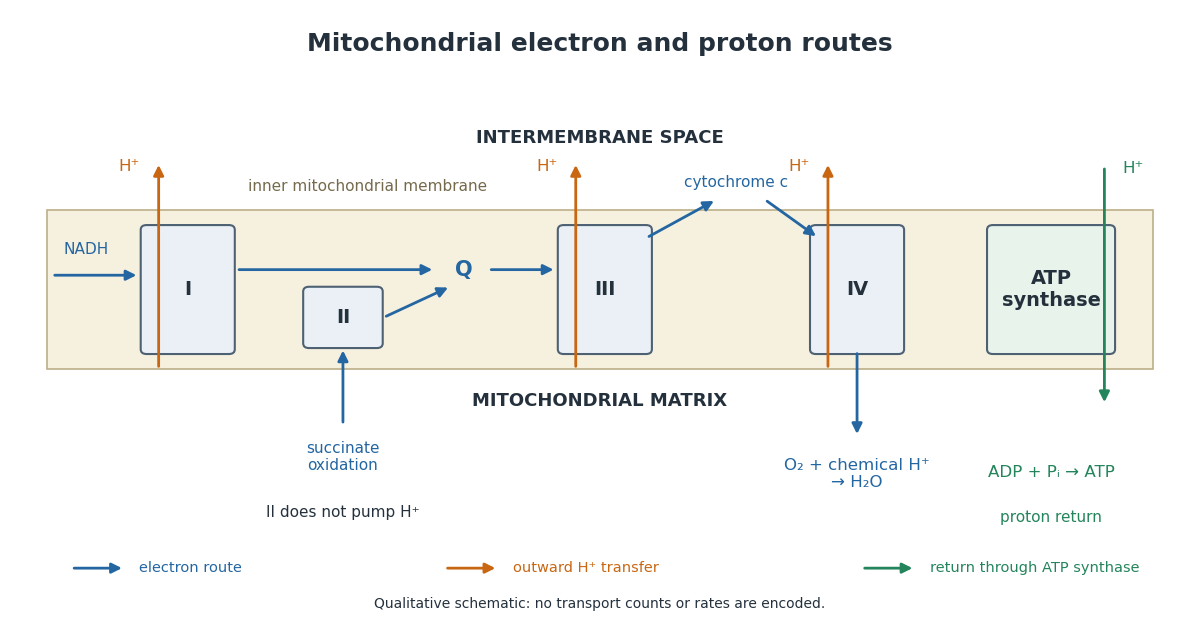
For an original electron balance, supply exactly of NADH to an ideal preparation with no other electron donor or competing electron acceptor. The donor supplies of electrons. Complete reduction of one oxygen molecule needs four electrons, so the corresponding oxygen consumption is . Adding the two formal half-reactions makes the result explicit:The cancelling electrons determine the donor-to-oxygen ratio. These chemical equations do not count transmembrane protons or determine an ATP yield. Chemical protons consumed in water formation and transported protons have different roles in the ledger.
Molar solubility 2026-10-18
The molar solubility is the amount of substance of a specified solid dissolved per volume of saturated chemical solution, under stated conditions. It counts dissolved formula units, not the sum of all dissolved ion concentrations. For AB with no initial A or B and no competing chemical reactions, one-to-one stoichiometry gives . For an AB solid, the corresponding concentrations are and .[ref]
15.1 Precipitation and Dissolution. Chemistry 2e by Paul Flowers and others; §15.1, Ksp and Solubility: dissolution coefficients relate molar solubility to individual ion concentrations
Monomer 2026-10-13
A monomer is a chemical substance whose molecules can undergo polymerization and contribute units to the essential structure of a polymer. A monomer molecule is the individual reactant; its incorporated monomeric unit is the portion identifiable as derived from that reactant. Incorporation can change chemical bonds and release small byproducts, so the unit in the chain need not have the complete molecular formula of the feed molecule. See IUPAC: monomer molecule and IUPAC, A brief guide to polymer terminology: monomeric units.
Three different counts answer three different questions. Monomer molecules describe the feed; monomeric units trace that feed's contributions to the product; a constitutional repeating unit describes the smallest chemical pattern repeating along a regular chain. In Nylon 6,10, two different monomers supply one interior constitutional repeating unit,Its molecular formula is . The diamine feed is , and the diacid-chloride feed is ; subtracting two gives the interior-repeat budget. For a finite linear chain made from of each reactant, there are joining connections, hence formal eliminations, rather than . One amine end and one acid-chloride end remain in that ideal unmodified chain. This is a stoichiometry check on the depicted reaction, not a claim that the washed experimental thread retains those ends. The reacting end-group chemistry is documented in Hammond, lecture 5, p. 4; the specified Nylon 6,10 reactant pair is reported in Polymer Day, nylon demonstration.
Ethene shows the reverse counting mismatch. One monomer molecule contributes a two-carbon monomeric unit to ideal linear polyethylene, without a small byproduct in that growth step. But the smallest constitutional repeating unit of its uniform backbone is just : a chain containing incorporated ethene monomeric units contains such interior one-carbon repeats. End groups are additional bookkeeping. The frequently drawn is useful for tracing the feed, although it is not the smallest constitutional repeat. The minimum-pattern definition is given in IUPAC: constitutional repeating unit; the ethene growth chemistry is described by [ref].
A segment of a freely jointed chain or Gaussian chain instead belongs to a statistical model. It can represent many chemical bonds and several constitutional repeating units; its length and the segment count are chosen to describe chain conformation at the intended scale. The three-repeats-per-segment drawing in Figure "From two liquid layers to a Nylon 6,10 thread: monomers, a constitutional repeating unit, and statistical segments" is a deliberately arbitrary coarse-graining example, not a measured Kuhn length. Always state the counting convention before substituting a segment count for a degree of polymerization. This separation lets chemistry track which chemical atoms entered the material while statistical models track how the material bends and extends.
Multiplication-cycle yield 2026-11-05
A multiplication-cycle yield specifies how successfully a cycle of a chemical multiplication reaction converts entering material into the intended output. It must state what happens to material that fails to complete the route. A stoichiometric multiplier alone is insufficient to determine the achieved gain.
Suppose successful processing produces copies of the measured species per entering copy, the success fraction is , and a fraction of unsuccessful material survives unchanged. The net cycle multiplier isHere represents survival of all failures and destruction of all failures. In an original example, and give when failures survive, but when they are lost. After five cycles the gains are approximately 118.8 and 79.6. The chemistry's failure pathway materially affects the answer.
For different cycle yields, total gain is . IUPAC's ideal direct-multiplication description gives for repeated identical cycles; the variable-yield expression follows by applying each cycle in sequence.[ref]
Cycle-gain uncertainty depends strongly on whether cycle errors are shared. Taking small perturbations,For independent multipliers with the same relative standard uncertainty , the relative uncertainty of is approximately . If one uncertain multiplier applies identically to every cycle, it is approximately . With and , these models give 3% and 9%, respectively. Repeating a shared error is different from averaging independent errors.[ref]
Evaluation of measurement data — Guide to the expression of uncertainty in measurement by JCGM. §5.2, correlated inputs; sensitivities here are derived for the stated gain model.
Measure standards over the intended cycle range, with matched chemical amplification blanks. Reagent depletion, side reactions or inhibition can make the actual multiplication-cycle yield change with time or amount. A nominal gain calculated from ideal stoichiometry does not replace that experimental test.
Native mass spectrometry 2026-10-20
native mass spectrometry transfers intact biomolecular assemblies into the gas phase under conditions intended to preserve noncovalent association sufficiently for mass analysis. Charge-state assignment and possible loss of subunits or bound lipids must be considered when inferring stoichiometry.
Net ionic equation 2026-10-14
A net ionic equation retains the chemical species changed by a chemical reaction and cancels spectator ions present unchanged on both sides. Dissolved strong electrolytes are represented by their separated ions, while a solid product retains its chemical formula. Cancellation preserves both elemental inventories and electric charge conservation.[ref]
Chemistry 2e by Paul Flowers and others. Chemistry 2e, §4.2, Precipitation Reactions and Solubility Rules: molecular and net ionic equations for silver chloride
For the calcium carbonate example, the complete ionic account isCanceling the sodium cations and chloride anions yields the net ionic equation above. Neither cancellation nor the conventional sodium chloride formula implies that the remaining dissolved ions have become paired molecules.
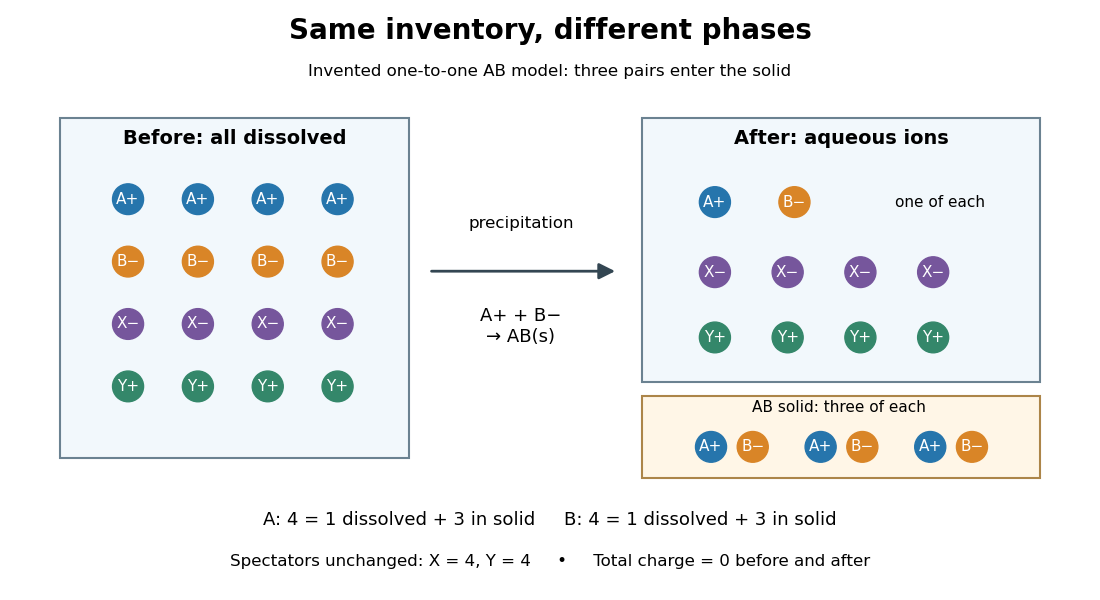
For this schematic, let be the amount of substance of AB formed. With no competing chemical reactions or losses,Adding each dissolved inventory to its contribution in the solid recovers its initial total. Each dissolved pair has net electric charge zero, so transferring a pair into neutral AB also preserves electric charge conservation. This is a short stoichiometry argument; choosing the actual additionally needs chemical equilibrium or chemical kinetics information.
Neutralization 2026-10-13
A neutralization is a chemical reaction between a chemical acid and a chemical base. In the buffer solution example, hydroxide takes a proton from the weak acid to form water and the conjugate base. The stoichiometry updates the partner inventories before the approximate chemical equilibrium calculation. The name does not require the resulting pH to be .
Nucleoside monophosphate 2026-11-05
A nucleoside monophosphate is a nucleotide with one phosphate group attached to a nucleoside. The nucleoside supplies a nucleobase linked to a sugar; the monophosphate specifies the phosphate count. Attachment position and sugar identity still matter. A common example is adenosine monophosphate, with a phosphate ester at the 5′ position of ribose; ChEBI identifies it specifically as adenosine 5′-monophosphate.[ref]
Adenosine 5'-monophosphate in ChEBI. CHEBI:16027, Definition and structure
The corresponding acid structure has molecular formula . Its single phosphorus atom provides a quick count, but the chemical structure is what identifies the 5′ attachment. The neutral acid formula is a stated representation; proton loss changes charge and hydrogen count without adding a second phosphate group.[ref]
Adenosine 5'-monophosphate in ChEBI. Formula, Net Charge and structure
A nucleoside diphosphate instead contains a linked pair of phosphate groups.A useful reaction is the adenylate kinase interconversionwhere the abbreviations denote adenosine triphosphate, adenosine monophosphate and adenosine diphosphate. The phosphate-unit balance is : a phosphate group is transferred rather than created.[ref]
Enzyme Nomenclature by the IUBMB. EC 2.7.4.3, Reaction: ATP + AMP = 2 ADP; iubmb.qmul.ac.uk/enzyme/EC2/7/4/3.html
For an original reaction-extent example, start with of ATP, of AMP and no ADP. A forward extent of leaves ATP, AMP and produces ADP. Both sides of this bookkeeping contain of phosphate units. This is a stoichiometry calculation for a specified extent, not a prediction of chemical equilibrium.
Nylon 6,10 2026-10-13
Nylon 6,10 has an amide-linked chain whose constitutional repeating unit contains a six-carbon diamine contribution and a ten-carbon diacid-derived contribution. See monomer for its stoichiometry and polymerization for the authored demonstration.
Oxidation state Created 2026-10-14 Updated 2026-10-20
An oxidation state is an electron-bookkeeping assignment to a chemical atom: its electric charge number after the ionic approximation of bonds. It helps identify oxidation and reduction and determine stoichiometry, even for covalent bonds without separate charged ions. In water, each hydrogen has oxidation state and oxygen has ; this does not assert that a water molecule contains two free protons and a free oxide ion.[ref]
Comprehensive definition of oxidation state (IUPAC Recommendations 2016) by Pavel Karen and others. Karen, McArdle and Takats, Comprehensive definition of oxidation state (IUPAC Recommendations 2016), §2, pp. 832–833: definition and equal splitting of same-element bonds
Three conventions answer different questions. Formal charge divides each bonding electron pair equally in a chosen Lewis structure. Oxidation state uses the ionic approximation of bonds. Partial atomic charge instead partitions the actual electron density and depends on that partition. In the ordinary water Lewis structure, every formal charge is zero although the oxidation states are not. Neither bookkeeping convention supplies numerical partial atomic charges.
Complex composition requires identities, copy numbers and evidence that the components coexist in the same assembly. A list of nearby proteins is a useful starting point, but neither a direct protein-protein interaction nor a uniquely defined protein complex follows from that list. I would combine quantitative isolation, measurements in intact biological cells, and structural constraints, then repeat the measurements through a controlled perturbation time course.
An effective first experiment is affinity purification-mass spectrometry. Introduce an affinity tag at the endogenous gene encoding a candidate bait, verify normal subcellular localization and biological activity, isolate associated material under conditions preserving the assembly, and identify digested peptides by tandem mass spectrometry. Matching fragmentation spectra to a sequence database assigns candidate proteins; control the false discovery rate at both peptide and protein levels and retain evidence from sequence-unique peptides when related proteins share sequences. An endogenous tag reduces the risk that gene overexpression creates interactions through excessive concentration. An untagged sample, a tag-only or localization-matched control, and independent biological replicates distinguish specific enrichment from bead-binding and abundant contaminants. Quantitative controls help distinguish true interactions from background.[ref]
SAINT: probabilistic scoring of affinity purification-mass spectrometry data by Hyungwon Choi and others. pp. 70–73, statistical distinction between true interactions and background using quantitative purification data
Isolation has selective losses. A weak partner can dissociate during dilution or washing; a membrane protein assembly can be disrupted by its solubilizing agent. Compare extraction conditions, check recovery in the soluble and insoluble fractions, and use reciprocal co-immunoprecipitation from an independent subunit. Treatment with a nuclease tests whether the association depends on DNA or RNA, but removal after extraction can itself destabilize a real nucleic-acid-dependent assembly. Purification from mixed tagged and untagged cell populations, with distinguishable stable isotope labeling, can test whether partners exchange after cell disruption. A reciprocal enrichment supports coassociation; demonstrating a direct contact still requires additional evidence.
For stoichiometry, raw mass spectrometry intensity is insufficient because different peptides have different digestion and ionization efficiencies. Use calibrated peptide standards or carefully normalized quantitative estimates, ideally with several reference subunits. native mass spectrometry measures intact assembly masses and can distinguish candidate subunit counts, while controlled dissociation helps assign subcomplexes. Bound lipids, post-translational modifications, gas-phase losses and heterogeneous occupancy complicate assignment, so check the mass against the summed masses of candidate subunits. Size-exclusion chromatography coupled to multi-angle light scattering independently constrains assembly mass, although an unresolved mixture produces an average and the hydrodynamic size alone is not a molecular mass. Quantitative mass spectrometry of protein complexes can combine interaction strengths, abundance and stoichiometry.[ref]
A human interactome in three quantitative dimensions organized by stoichiometries and abundances by Marco Y. Hein and others. pp. 712–723, integration of interaction strengths, abundance and stoichiometry
To avoid requiring a bait, fractionate native extracts by size-exclusion chromatography or another separation and quantify proteins in every fraction. Correlated elution profiles suggest membership of the same protein complex; comparison across an independent separation helps distinguish coincidence. This co-fractionation mass spectrometry can also reveal shifts from a large assembly into smaller forms after treatment. It may merge different assemblies sharing a subunit, and a failure to coelute does not exclude a transient interaction. chemical cross-linking mass spectrometry adds spatial information: identify pairs of linked residues, translate them into distance restraints appropriate to the reagent and residue accessibility, and ask whether a proposed assembly can satisfy them. A cross-link is a proximity constraint, not automatically a permanent interface; intermolecular assignment is especially difficult for identical subunits.
In living biological cells, proximity labeling captures an interaction neighbourhood before disruptive extraction. A bait fused to TurboID marks nearby proteins with biotin, allowing stringent enrichment and mass spectrometry. The original TurboID work demonstrated useful labeling over roughly ten minutes, which is much faster than older long-labeling implementations.[ref]
Efficient proximity labeling in living cells and organisms with TurboID by Tess C. Branon and others. Fig. 2 and Supplementary Figs. 7–11, labeling-time and compartment comparisons
A localization-matched enzyme control, a no-added-biotin control and matched fusion abundance are essential. The labeling pulse integrates both spatial proximity and residence time; ten-minute labeling cannot resolve a seconds-long interaction sequence. Changes in ATP, biotin availability, enzyme activity or access to reactive residues can change the labeling signal independently of complex membership. A pulse followed by a chase does not make the covalent label disappear when the partner leaves.Structural methods distinguish alternative interpretations of these measurements. cryo-electron microscopy can assign ordered subunits, estimate occupancy of resolved features, and separate some compositionally different particle classes. Flexible or small subunits may remain invisible despite being present. X-ray crystallography resolves stable interfaces but selects material that crystallizes. Förster resonance energy transfer between appropriately positioned labels tests nanometre-scale proximity in intact biological cells; single-particle tracking and fluorescence correlation spectroscopy can test comobility and exchange. Label placement, spectral cross-talk and accidental colocalization require controls. None of these techniques by itself reliably inventories every component.
The computational analysis should preserve these distinctions. Construct a protein interaction network with separate edge types for copurification, cross-linking and proximity labeling. Cluster reproducibly supported associations to propose modules, distinguish a stable core from variable accessory components, and integrate localization and measured protein abundance. Models such as AlphaFold 3 can propose interfaces for experimentally supported candidate components, but a confident predicted geometry does not demonstrate that an interaction occurs in the tested condition.[ref]
Accurate structure prediction of biomolecular interactions with AlphaFold 3 by Josh Abramson and others. pp. 493–500, joint structural prediction of biomolecular complexes
Test interfaces by site-directed mutagenesis, confirming normal protein folding, expression and localization before interpreting a lost interaction. Evaluate a proposed assembly against independently held-out cross-links or other measurements to reduce circular validation.For perturbations, use vehicle controls, several doses and early-to-late sampling; randomize preparation and instrument order. Quantify input abundance alongside bait-normalized partner recovery. An illustrative relative recruitment statistic for partner at time iswhere is background-corrected recovered intensity, is the bait and is input abundance. This is an operational comparison under matched extraction and measurement response, not an absolute occupancy or dissociation constant. A doubled recovered partner signal with doubled input abundance and unchanged bait recovery gives , illustrating why raw enrichment alone would mislead. Values near the detection limit need uncertainty bounds rather than unstable ratios.
A drug-induced loss of several core components could mean disassembly, degradation, changed localization or poor recovery. Distinguish them with input proteomics, microscopy and native fractionation, then test reversibility after washout and rescue by a drug-resistant target when feasible. For stress, monitor viability and extraction-resistant material; for disease-associated mutations, compare otherwise matched genetic backgrounds and rescue with the normal allele. post-translational modifications may recruit an accessory partner without changing the core. hydrogen-deuterium exchange mass spectrometry can then test interface exposure, but its altered exchange reports accessibility and structural dynamics rather than a new subunit by itself. A convincing remodeling claim is a reproducible change in assembly membership or occupancy, separated from changes in abundance, localization and assay recovery, and connected to a functional consequence.
The recovered vesicle fractions contain bands at the expected positions for the supplied SNARE proteins. The v-SNARE preparation contains its principal band, and the t-SNARE preparation contains both t-SNARE and the SNAP25 doublet. Thus protein-containing vesicle fractions have been recovered, consistent with successful reconstitution.
The SDS-PAGE experiment does not establish the orientation of the proteins, their proportion facing outward, the stoichiometry in an individual vesicle, or membrane fusion. Nor does a stained band prove that all of its protein is correctly folded and active. Those are separate functional and membrane topology questions.
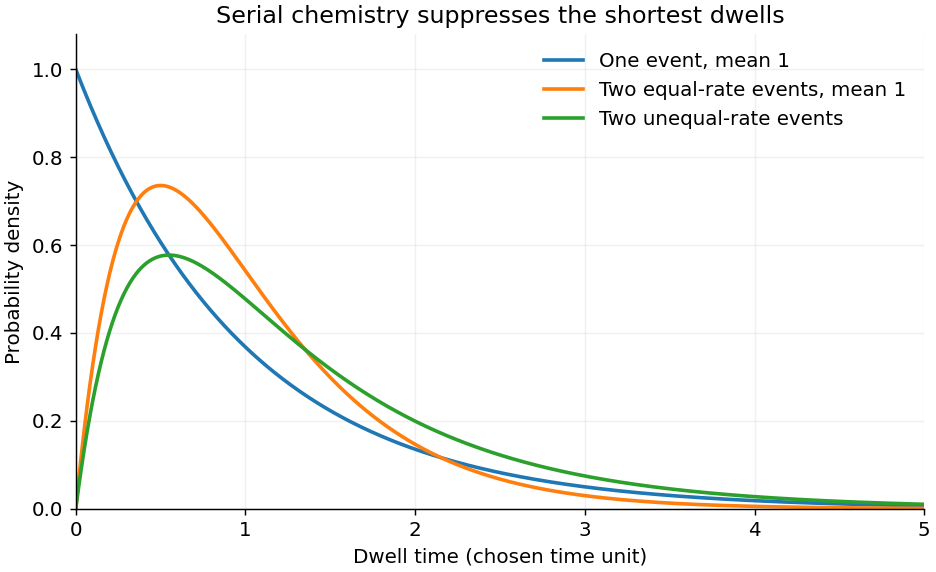
At saturating ATP, binding need no longer dominate the observed dwell, but saturation alone does not determine a dwell-time distribution. The standard interpretation of a distribution that rises from zero is that at least two sequential events remain rate limiting. Model a dwell as , where the independent waiting times are distributed according to exponential distributions with rates . Their convolution isThis hypoexponential distribution starts at zero, rises to a mode , then has an exponential tail. When the rates are equal, the continuous limit is the two-stage Erlang distribution,A single slow memoryless event instead gives , maximal at zero. Three 120-degree steps per revolution specify rotational stoichiometry, not three slow reactions within every dwell. The two-event interpretation is supported by the resolved catalytic-dwell chemical kinetics in the primary F1 experiment.[ref]
Resolution of distinct rotational substeps by submillisecond kinetic analysis of F1-ATPase by Ryohei Yasuda and others. 2001, abstract and Figure 8: two reactions occupy the catalytic dwell
The fit assumes sequential approximately irreversible events, constant rates during each dwell, negligible ATP-binding delay, negligible mechanical transit time, and detection of all relevant steps. Parallel pathways, backward transitions, inhibited states, probe drag and missed short dwells can change the histogram. The mathematical fit alone does not identify each event chemically or prove that two ATP molecules are hydrolyzed per step.
Let and use a one-molar standard state, so the inorganic phosphate activity is approximately . With the source's stated standard hydrolysis value,The downhill proton-transfer Gibbs free energy is for the signed driving force V. Ideal reversible balance of one complete turn requiresSolving yieldsAt 298.15 K the estimate is . Temperature is not specified in this paragraph; the first value explicitly adopts physiological temperature rather than pretending it is supplied. The unexpectedly large ADP/ATP ratio follows from using the printed standard value kJ/mol with the stated dilute inorganic phosphate. One must not silently replace that value by another convention or treat it as the already concentration-corrected cellular hydrolysis Gibbs free energy.
This estimate assumes ideal thermodynamic activities, consistent pH and magnesium conventions, tight coupling of ten protons to three ATP, no leak or transport overhead, and operation close to reversible balance. A working cell is not in global equilibrium. Net synthesis at this fixed driving force requires , hence above this reversible-balance threshold; finite chemical kinetics and dissipation prevent the stoichiometry alone from determining an exact physiological ratio.
Past exam of the chemistry B course of the University of Cambridge 2022 Paper 2 B6 c Solution 2026-10-20
Four equivalents of base remove the four carboxylic-acid protons from two ligand molecules, giving two dianionic pyridine-2,5-dicarboxylate linkers per Pt/Mn pair. The ring nitrogen and neighbouring 2-carboxylate supply a five-membered N,O chelate. A consistent chain has Pt(II), NO, with square planar molecular geometry, and Mn(II), O, with octahedral molecular geometry.
At each Pt, two ligands bind through their ring N and one O of the adjacent 2-carboxylate; their remote 5-carboxylates point toward successive Mn sites. At each Mn, a remote carboxylate from each of two neighbouring Pt-containing units binds through both O atoms. Two coordinated water molecules complete Mn's six-coordinate sphere. The repeating connectivity, with each bracket denoting a single organic linker, isEach Pt has a second N,O chelate extending in the opposite chain direction; each Mn similarly receives two carboxylate chelates. The original donor-connectivity diagram makes those counts explicit.
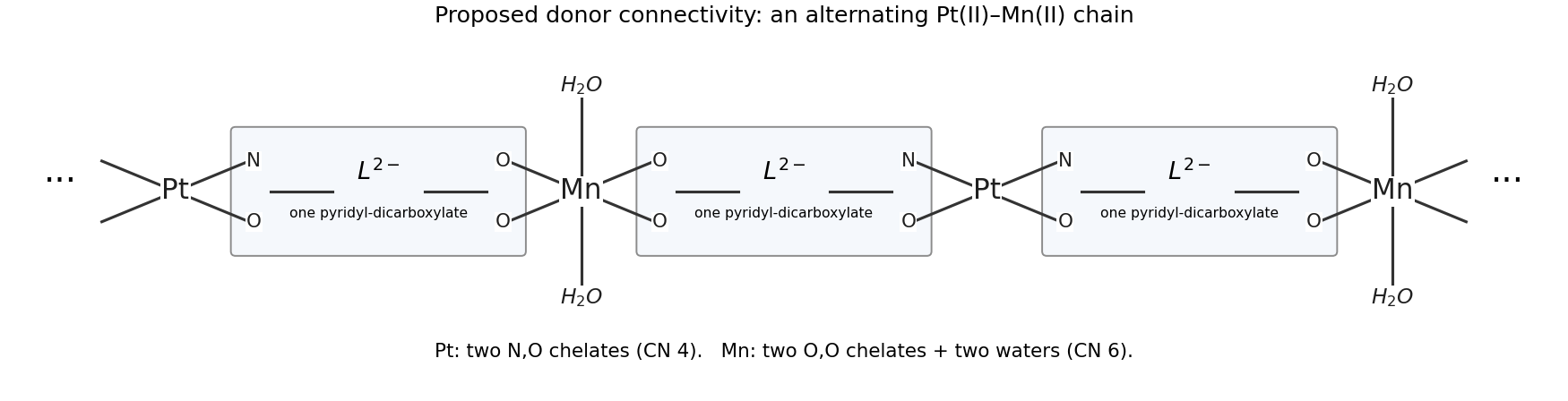


Pt(II) is and strongly favours square planar molecular geometry. Its affinity for the pyridyl N donor and the chelate effect select the mixed N,O pocket. Mn(II) is high-spin , is harder, and favours the carboxylate and water O donors; six-coordinate octahedral molecular geometry is natural in water. Charge balance per repeat is . A suitable repeat formulation is . This is a justified proposed coordination chain, not a unique crystal structure established from stoichiometry alone; water content, carboxylate bridging modes and actual porosity require structural characterization.