The minimal polynomial is the monic polynomial of smallest degree satisfying . An annihilating polynomial exists, for example because are linearly dependent in the -dimensional space of matrices. A nonzero constant cannot annihilate , so the minimal degree is positive.
If and are two such monic polynomials of minimal degree , then and unless . Minimality therefore forces . Polynomial division also shows that divides every annihilating polynomial: the remainder after division would otherwise be an annihilator of smaller degree. This proves uniqueness rather than merely choosing one of several minimal-degree polynomials.
If is real, coefficientwise complex conjugation of gives . The conjugated polynomial is monic of the same degree, hence uniqueness gives . The minimal polynomial of a real matrix has real coefficients.
For , use the block diagonal matrixThe two-dimensional Jordan block is annihilated by but not by , while the scalar block requires the factor . A polynomial annihilates the direct sum exactly when it annihilates every block. Thus its minimal polynomial is the least common multiple . For the final identity block is omitted.
In the upper half-plane model the hyperbolic metric isThe length of a differentiable curve is . The area element is the square root of the metric determinant times , so the hyperbolic area of a measurable region is .
The Gauss-Bonnet theorem for a geodesic hyperbolic triangle of angles in curvature gives area ; an ideal vertex has angle zero. The horizontal edge in the present region is not a geodesic, so it is simpler to use the area element directly:The open boundary does not affect the integral because its area is zero.
Write the holomorphic function as . Analyticity gives smooth real and imaginary parts satisfying the Cauchy-Riemann equations , . Differentiating these identities showsThus both parts are harmonic functions. The product rule then givesSince , this proves the Laplacian identity for the squared modulus of a holomorphic function,
Interpret as the rest mass of each initial ball and assume that no energy or momentum escapes the collision. Let be its Lorentz factor. The total initial energy and momentum areTheir conservation determines the final four-momentum. For a single lump, and , henceThe final invariant mass follows from :This is the rest mass of a coalescing relativistic collision. For , : some kinetic energy becomes internal energy in the final rest frame. Setting would discard that energy and contradict conservation. At small speeds , while gives .
The displayed evolution law uses the usual assumptions of incompressible flow, constant density and conservative body force. With , the Euler equation isUse and take a curl. Gradients have zero curl, andHere because it is a curl, and by incompressibility. The vorticity equation is thereforeThe material derivative combines local change with advection by fluid particles. The right-hand side is vortex stretching and tilting: spatial variation of velocity along a vortex line changes its strength and direction. Along each particle path this is a homogeneous linear equation for vorticity. For a smooth velocity field its solution with zero initial vorticity remains zero by uniqueness. Thus an initially irrotational flow remains irrotational while these assumptions and smoothness hold.
For a plane flow , the vorticity is and . Hence . Every particle retains its initial value, so an initially uniform value givesInviscid motion alone is insufficient for the printed simplified law: compressible variable-density motion generally adds . Those terms vanish under the assumptions used above.
Use columnwise partial pivoting: select the largest absolute entry in the current column and interchange rows. In the first column the pivot is , so interchange rows 1 and 2. The multipliers are and , and elimination givesThe second pivot is , so interchange the two remaining rows. Their previously stored first-column multipliers must also be interchanged. The final multiplier is , giving the LU decompositionThe permutation matrix orders the original rows as . Multiplication verifies the displayed identity.
If “column pivoting” instead denotes interchanging columns rather than searching within a column, that convention gives withThis second identity uses a different pivot convention; it does not change the row-pivoted answer above.
At the first step of Gaussian elimination, the first column of a nonsingular matrix cannot be zero. Choose a nonzero pivot there using a row interchange and eliminate below it. The resulting matrix has block formElementary elimination and row permutations preserve nonsingularity, so and the trailing matrix is nonsingular. Its first column again has a nonzero entry. Repeating this argument inductively provides a nonzero pivot at every step and produces an upper-triangular factor. The recorded elimination multipliers, with previous entries permuted when necessary, form the unit lower-triangular factor. Every nonsingular square matrix admits under columnwise partial pivoting.
For the column-interchange convention from part (a), use the same induction with a nonzero entry in the first row of each nonsingular trailing matrix. Column interchanges put it in the pivot position, and elimination gives . These existence statements are in exact arithmetic; they do not assert that all choices have equally good numerical stability.
For the independent normal distribution observations, the log likelihood isIts derivative is and its second derivative is , so the unique maximum-likelihood estimate isFor the prior with , multiplying prior density by likelihood and completing the square givesThus normal-normal conjugacy gives the posterior distributionFor quadratic loss, the conditional expected loss of action is the posterior variance plus . Its unique minimizer is the posterior mean, so the Bayes estimator isThis weights the sample and prior means by their respective precisions.
For maximization of subject to and , the Lagrangian sufficiency theorem says: if a feasible globally maximizes , where , and , then globally maximizes over the feasible set. Indeed, at every feasible ,This requires a global maximum of the optimization Lagrangian; a stationary point alone is not sufficient without additional concavity or another justification.
Put and . If every , the maximum is zero and every feasible vector is optimal. Otherwise setSince , . For , the optimization Lagrangian is . Its gradient vanishes at becauseThe function is a strictly convex function for , so is a strictly concave function. Its supporting-hyperplane inequality proves that this stationary point is its global maximum. Complementary slackness and feasibility hold, so the sufficiency theorem applies. Substitution givesThe maximizing vector is unique when . It is the norming vector for Holder inequality, and the value is the corresponding dual norm.
For a linear map , its rank of a linear map is , and its nullity is . Choose a basis of its kernel and extend it to a basis of . Then span its image. They are linearly independent: a linear combination mapped to zero would belong to the kernel, contradicting independence of the extended basis unless all its coefficients vanish. Hence , provingFor endomorphisms of , define and . The image of the sum lies in the sum of the two images. ThusTo prove the product inequality, restrict to . This map has kernel and image : every vector in the intersection has a preimage in . Applying the rank-nullity theorem to the restricted map givesNow put and . If both equalities hold, , while forces . Therefore , the sum has full rank, and the product has nullity . The sum is an isomorphism and the product is zero.
Conversely, if , then , giving . If the sum is also an isomorphism, its rank is . Thus , and the two inequalities become equalities. This proves the equality in the rank-sum and nullity-product inequalities in both directions.
Use the following standard facts: has order and is a nonabelian simple group; the coset action on the cosets of an index- subgroup is a transitive homomorphism into . If has index , that action is nontrivial. Its kernel is a normal subgroup, hence is trivial by simplicity. It would therefore embed in . For this is impossible since . There are no subgroups of indices 2, 3 or 4.
An index-5 subgroup has order by Lagrange's theorem. Consider its natural action on the five letters. It cannot be transitive, since an orbit of size 5 would divide its order by the orbit-stabilizer theorem. If it had no fixed letter, its orbits would have sizes 2 and 3. It would then be a subgroup of the permutations preserving that partition, namely . Exactly half of those 12 permutations are even, so has order 6, too small to contain .
Thus fixes a letter . The stabilizer of in is the copy of consisting of even permutations of the other four letters; it has order 12. Containment and equality of orders force to equal that stabilizer. Conversely each such stabilizer has index 5. ConsequentlyThese five subgroups are distinct: for , a three-cycle on letters other than can move , so it belongs to the stabilizer of but not that of .
Let . Under the first coefficient bounds,This proves the uniform Cauchy condition on the whole real line and hence uniform convergence to . It is the Weierstrass M-test applied with the summable majorant . Every partial sum is continuous. To see continuity of the limit explicitly, at a chosen first choose with small uniform error; then make small by continuity. The inequalityproves continuity. Also for every , so taking limits gives .
Under the stronger coefficient bounds, the derivative series has summable uniform majorant . Thus converges uniformly to a continuous function given by that series. The original series also converges uniformly. On any finite interval, the fundamental theorem of calculus gives . Uniform convergence permits passage to the limit inside this finite integral, since the error is at most . Therefore , and continuity of gives . This justifies Termwise differentiation of a Fourier series rather than assuming it:
The product topology on consists of arbitrary unions of rectangles , with open in and open in . Equivalently, these rectangles form a basis.
The empty set is the empty union, and is itself an allowed rectangle. An arbitrary union of sets of this form is still a union of allowed rectangles. Finally,which is an allowed rectangle because the factor topologies are closed under finite intersections. Distributing intersection over unions shows that the intersection of any two product-open sets is product-open; induction handles all finite intersections. These verify every topology axiom. Rectangles alone are generally not a topology, which is why their arbitrary unions are included.
Parametrize the logarithmic spiral byThe map is continuous into the ambient plane, hence into with its subspace topology, and it is onto by the definition of the spiral. It is injective because its radius determines uniquely, even when the angular coordinate winds through repeated turns.
Every point of is nonzero. The inverse is thereforethe restriction of a continuous function on the punctured plane. Hence is a homeomorphism and the spiral is homeomorphic to the real line. Its accumulation at the origin causes no failure of this argument: the origin is not included in .
Let and integrate counterclockwise around the rectangle with vertices . It contains a single simple pole at , with residueOn the top edge , and its orientation reverses that of the bottom edge. On the right edge , so its integral tends to zero for . On the left , which tends to zero for . The residue theorem therefore givesSince ,The restriction is also necessary for ordinary convergence: at the integrand behaves as , requiring , while at it behaves as , requiring . At either endpoint one tail approaches a nonzero constant; outside this range one tail grows. There is no cancellation because the real integrand is positive.
In orthonormal Cartesian coordinates, a second-rank tensor has components transforming under a change of axes as , where . Its contraction is invariant:Thus is a scalar. This is tensor contraction with the Euclidean metric. In general nonorthonormal coordinates the invariant expression is , not an unweighted sum of diagonal covariant components.
For the planar plate, every mass element has . The inertia tensor is consequentlyIt follows directly that is an eigenvector andThe real symmetric matrix has three real eigenvalues. Its trace is , so . Hence the perpendicular axis theorem gives .
For a disc of constant areal density , symmetry gives , and polar integration gives . Thereforewhere the scalar in the last expression denotes the total mass rather than the tensor.
No: ordering the attractive potentials does not impose the proposed ordering of reflection probabilities. Take and let denote the particle mass. Choose everywhere andThese satisfy every stated ordering and support condition. The incoming energy is ; the interior wavenumber in the finite square well is .
Here is an explicit matching calculation. For a general well of width , take exterior waves on the left and on the right. Shifting the incident phase in this way does not change the reflection probability. Continuity of the wavefunction and its first derivative gives the propagation relationInverting it and adding the two equations after dividing the derivative equation by yieldsThe incident and reflected exterior waves have the same speed, so their flux ratio isFor the chosen parameters and . ThusThe zero potential has no reflected component. This proves the failure with explicit probabilities. More generally the same expression vanishes at , explaining resonant transmission through a square well and why increasing attractive well depth does not monotonically control reflection.
Take zero electric potential at infinity and put . By spherical symmetry and Gauss's law, the electric field is radial, with magnitude determined by the total enclosed electric charge. Thus, away from the idealized shell surfaces,Integrating from infinity, or adding the three spherical-shell potentials, givesThe expressions agree at each interface, so the potential is continuous everywhere, including the origin. The electric field has different interior and exterior limits at each infinitely thin charged surface, with jump equal to surface charge density divided by . An ideal sheet has no single classical field value on the sheet itself; the displayed adjacent limits specify the field there. In conducting material of nonzero thickness the internal field is zero.
The electrostatic energy is the integral of . There is no contribution from , and spherical integration givesThe dependence on cancels because the magnitude of enclosed electric charge is on both sides of the middle shell, even though the field direction changes.
Define source strength here as the volume flux through a small sphere around the source. For incompressible potential flow, and the governing conditions areEquivalently the Laplace equation holds away from the source, with local behavior . The boundary condition expresses impermeability. The method of images uses an equal source below the plane:The image singularity lies outside the fluid, the two vertical derivatives cancel on the wall, and the source has the specified outward flux.
Let . On the wall and the tangential radial velocity is . With ambient pressure , the steady Bernoulli equation in this irrotational flow givesThe fluid pressure is reduced everywhere on the wall except at its axis and in the infinite-distance limit. The finite hydrodynamic force is the excess over the uniform ambient-pressure force. Integrating its magnitude over the plane yieldsPutting gives the last integral as . HenceRelative to ambient pressure on the other side, the boundary is attracted toward the source. This is the hydrodynamic attraction of a plane wall to a point source.
There is an alternative source-strength convention: if denotes the coefficient in rather than total volume flux, replace the flux above by . Then , , and . The physical result is identical once the normalization is fixed.
A sufficient statistic for is a function of the observations whose conditional distribution of given does not depend on , whenever that conditioning event is possible. It retains all parameter dependence of the likelihood.
In the discrete case the Fisher-Neyman factorization theorem provides a direct criterion: , where is independent of the parameter. To justify sufficiency, for a value with positive probability, sum this expression over its fiber and divide:The parameter-dependent factor cancels. Conversely, parameter-independent conditional probabilities give the factorization with . Thus the criterion is both necessary and sufficient, with conditional laws only required on fibers of positive probability.
For the shifted exponential sample the likelihood isIt factors through , so the sample minimum is a sufficient statistic. Writing , independence gives for Therefore is exponential with rate . Its mean is and its variance is . The unbiased endpoint estimator for a shifted exponential sample is consequentlyAlthough the parameter is nonnegative, this unbiased estimator can be negative. Truncating it at zero would change its expectation and lose the requested property of an unbiased estimator.
For the natural filtration , a stopping time takes values in and satisfies for each . Whether it has occurred by time can be decided from the observations through that time.
The Strong Markov property for a time-homogeneous Markov chain says that, on , conditional on , the process has the law of a fresh chain started at . In particular its future conditional law depends on the past only through . For example on that event, and the corresponding statement holds for every finite future path.
Start at and let , , with . These are stopping times. Put . Each finite return restarts the chain at , so the Strong Markov property gives inductivelyThe events decrease as increases; infinitely many visits occur exactly when every return time is finite. Continuity of probability therefore givesNo irreducibility assumption is needed for this zero-one conclusion at the starting state.
Let , counting the initial visit. Summing nonnegative random variables and then using the tail-sum identity givesIf , this is . Thus divergence of the given sum forces , and infinitely many visits then occur with probability one. This proves the recurrence criterion by return probabilities directly from the regeneration at return times; divergent probability sums alone would not suffice for arbitrary dependent events.
Sylvester's law of inertia says that any real quadratic form has coordinates in which it is a sum of positive squares minus negative squares, with unused coordinates, and that the numbers are invariant under every invertible linear change of coordinates. Its rank is ; its signature of a quadratic form is commonly , with also called its signature pair.
The symmetric matrix here is , where and . On the line spanned by , has eigenvalue . If , then , so that the orthogonal complement has eigenvalue with multiplicity . Thus the off-diagonal all-ones quadratic form hasFor the form vanishes, so rank and scalar signature are both zero, with inertia . Including this case is necessary because the distinguished eigenvalue then becomes zero.
A Euclidean domain is a commutative integral domain with a function such that, for with , there are satisfying , where either or . One may also impose the usual monotonicity for nonzero ; the example below has it.
The integers form a Euclidean domain that is not a field. Use . Integer division by supplies a remainder with , and changing the sign of the quotient handles negative . The integers are an integral domain, while has no multiplicative inverse in them. This verifies both the Euclidean property and the failure to be a field.
The structure theorem for finitely generated modules over a principal ideal domain applies because every Euclidean domain is a principal ideal domain. In invariant-factor form, every finitely generated module over such a domain has a decompositionwhere the are nonzero nonunits, , and either list of summands may be empty. The free rank and the invariant factors are unique up to multiplication of each by a unit. Equivalently the torsion part is a direct sum of cyclic modules with prime-power annihilators. The nonunit convention omits zero summands .
Change the generators to , and . This is an invertible integer change of generators, since , , . The relations become and , with no relation involving . ConsequentlyThis is already the invariant-factor order required by the structure theorem for finitely generated modules over a principal ideal domain, because . The inverse change of generators shows that there are no hidden extra relations.
Uniform convergence of to on an interval means that for every there is such that for all and every . Equivalently . The same must work throughout the interval, unlike pointwise convergence.
For completeness, continuity is preserved: choose with uniform error below , and use continuity of at a given to make . The triangle inequality then gives . Thus each function involved in the integral is continuous on the closed interval and Riemann integrable. The estimateproves convergence of the integrals by uniform convergence. When both integrals are zero.
For each fixed , , so the only possible limit is zero. But taking gives for every . In fact the supremum of over the interval is infinite for each . Thus the convergence is pointwise but not uniform; uniform convergence cannot be inferred from convergence at each fixed point.
The pointwise limit is the constant function . For , the inequality for givesHence the sequence converges uniformly to one on . Its exact supremum error is , although the supremum is not attained on the open interval. Compactness of the interval is not needed for this uniform convergence bound.
The equation implies . Its intersections with and are disjoint, nonempty subsets open in the subspace topology, and together cover the entire surface. They therefore form a separation, proving the surface is disconnected. More precisely its two sheets are ; each is homeomorphic to the connected plane by projection, so these are exactly its two connected components.
Factorization gives or . Each point can be joined to the origin by a straight segment lying on its own line. Two such segments join any pair of points, so the union is path-connected and hence connected. Alternatively it is the union of two connected lines with a common point.
The map is a continuous surjection from the path-connected plane onto this surface. It is a homeomorphism because coordinate projection is its continuous inverse. Thus the paraboloid is path-connected and connected. Explicitly, lifting any straight planar segment by this map produces a path on the surface.
At a constrained stationary point where , every tangent direction to is orthogonal to . Vanishing of the directional derivative of in all such directions forces for a Lagrange multiplier . Solve these equations together with the constraint, then check the candidates and any singular or limiting cases for minima or maxima.
Let a closed cylinder have radius and height , with fixed . Its area is and the constraint is . The Lagrange multiplier equations giveThe second yields ; substituting into the first gives . Thus the minimum-area closed cylinder at fixed volume hasTo prove it is the global minimum, eliminate to obtain . Its derivative is , negative before the displayed radius and positive afterwards; the area tends to infinity both as and as . This establishes uniqueness and rules out limiting smaller areas.
Take the divergence of the Ampere-Maxwell law and use Gauss's law . Since the divergence of a curl is zero, this gives the charge continuity equation . Uniform conductivity and Ohm's law imply . ThereforeThe spatially uniform initial density stays uniform in the interior; is the charge relaxation time.
Denote the cylinder radius by . Cylindrical symmetry makes the interior electric field radial. Gauss's law on a coaxial cylinder of radius and length gives . ThusThe current does not disappear at the interface: the vacuum conducts no current, so charge accumulates on the cylindrical surface. Initially taking the charge to be the stated volume charge alone, its surface charge density satisfies , giving the charge relaxation in an isolated conducting cylinder lawThe total enclosed charge per unit length is . Consequently the exterior electric field isindependent of time. The boundary jump obeys , as it must. Applying Gauss's law to the decaying volume charge alone would incorrectly predict a decaying exterior electric field and violate electric charge conservation. The vector formulas also specify the inward direction if .
Write for coordinates in the rest frame of and for those in the rest frame of . The Lorentz transformation is and . Along the worldline of , . Cancelling gives , so the relativistic velocity-addition formula yieldsApply the same Lorentz transformation between the rest frames of and to . Its velocity in the former is . Substitution simplifies toHere and the formulas use signed collinear velocities. In the given positive-direction setting they are positive speeds. The limit recovers ordinary addition, providing a check on both expressions.
A material derivative measures the rate experienced by a moving fluid particle. If its position is with , the chain rule for any scalar field givesHence the operator is , and the material derivative differs from the time derivative at a fixed spatial point.
In the steady temperature problem and the transverse velocity vanishes. Thus at each fixed ,Integrating in and applying the inlet value givesA particle's travel time from the inlet is , so the formula is also the exponential decay along its characteristic curve. For fixed the temperature tends to zero near either wall, because the travel time becomes large. No value at is imposed by an inlet condition there, since the wall velocity is zero and the stated channel is open in .
A cut of a flow network of a directed flow network is a partition with the source in and the sink outside it. Its cut capacity is . Summing flow conservation over all vertices of cancels every internal edge and gives the flow value as outgoing flow minus incoming flow across the cut. Incoming flow is nonnegative and outgoing flow is bounded by capacity, soThis is weak duality for the maximum-flow problem; no converse theorem is needed for the upper bound.
For this grid, use . It contains but not . An adjacent edge can leave only by reaching the diagonal. Each of the three interior diagonal vertices has two incoming crossing edges and each endpoint has one, making eight edges. Every crossing edge has capacity one. Thus the diagonal cut in a nearest-neighbour lattice flow has capacity eight.
Here is a feasible flow of value eight. Send one unit on each of the following directed paths, and zero on every edge not used. In this list abbreviates the vertex :Every path conserves flow at its intermediate vertices. To check the capacities without hiding a feasibility assumption, group used edges by capacity: the capacity-one edges are traversed at most once; the capacity-two edges at most twice; the capacity-three edges at most three times; the capacity-four edges at most twice. Shared source edges , , carry units, and the corresponding three sink edges carry . The diagram displays every positive edge flow beside its capacity. Thus all constraints hold and the matching cut proves
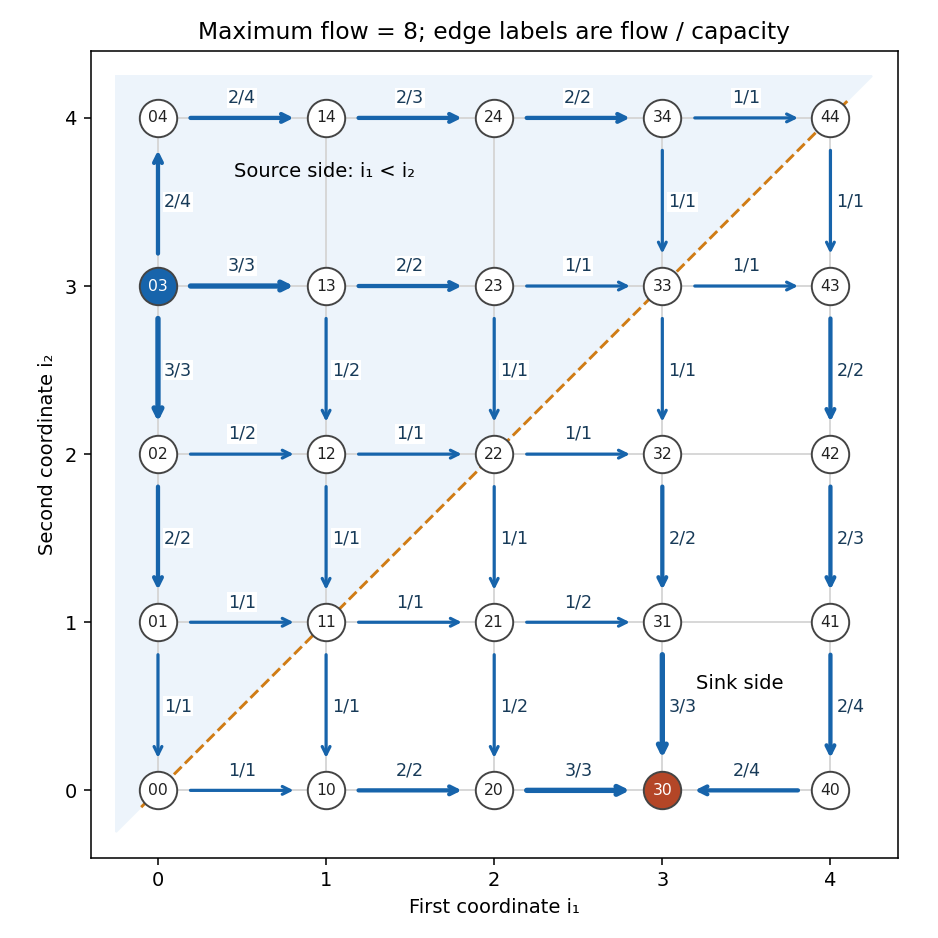
Feasible eight-unit grid flow with edge labels showing flow over capacity and the diagonal cut of capacity eight
. Details. 
The monomials are linearly independent and span, so . Use the factorial monomial basis for polynomial differentiation , . Direct differentiation gives . HenceIndeed every has the Taylor expansion ; evaluation on the proves independence of the functionals. Derivative orders include zero. If one uses a convention excluding zero from , must explicitly be included, since all positive-order derivatives annihilate constants and cannot span the dual space.
Differentiation satisfies and for . With column vectors of coefficients, its matrix has entries if and zero otherwise, for indices :The dual map is , not a conjugate-linear adjoint. Thus for and . Therefore in the corresponding dual basis. For both matrices are the one-by-one zero matrix.
Let be the set of all subsets of with elements. First show that is not divisible by . In the polynomial ring over the field of elements, , since the intermediate binomial coefficients are divisible by . Iterating givesComparison of coefficients of yields .
Let act on by left translation. Because its orbit sizes sum to a number not divisible by , some orbit has size prime to . Choose a subset in that orbit, with stabilizer . The orbit-stabilizer theorem gives the orbit size , so . On the other hand acts freely on the elements of : if , cancellation in the group gives . Every -orbit in therefore has elements, and divides . Sinceand the second factor has no factor of , the first must contain all . Hence , proving the first of the Sylow theorems. This is Sylow existence by subset action and includes the trivial case .
The remaining Sylow theorems state that every -subgroup of a finite group is contained in a Sylow subgroup, and that all Sylow -subgroups are conjugate. If with and is the number of Sylow -subgroups, thenIn particular if and only if that Sylow subgroup is a normal subgroup.
Relabel the two primes so that . By the Sylow theorems, the number of Sylow -subgroups divides , so it is either or . But and , ruling out . Thus there is a unique Sylow subgroup of order , which is a normal subgroup. It is nontrivial and proper because . Consequently no group of order is simple. No additional assumption on divisibility of by is required.
The second fundamental form records the normal component of second-order bending of the surface. For a surface curve , the terms containing and are tangent and thereforeThus on a unit tangent direction it gives the normal curvature; for a general coordinate direction the normal curvature is the ratio of the second to the first fundamental form. Equivalently the quadratic part of displacement out of the tangent plane is one half of this form. Reversing the chosen unit normal changes its sign.
Now suppose . Differentiate . This givesAlso differentiation of gives . The parametrization is regular, so form a basis of three-dimensional space. Both normal derivatives are orthogonal to this basis and hence vanish:The parameter ball is connected; integrating these derivatives along a straight segment between parameter points shows that is constant. Finally both derivatives of vanish, because are tangent. Thus the zero second fundamental form implies planar image statement isThe PDF has in the second derivative equality; the apparent in the TeX is not a distinct coordinate.
If with and , the chain rule gives , the product of a two-by-one and a one-by-two matrix. Its rank is at most one, so its Jacobian determinant is identically zero.
Conversely, continuity and give a neighborhood on which stays nonzero. The identity then implies . Therefore the smooth function satisfiesFor a graph curve with constant, the first component must have derivative zero. Thus the necessary equation isIt is also sufficient: it makes , and then .
To justify the existence through every nearby point, choose a closed rectangle about the origin inside . The right-hand side is smooth there, hence bounded and locally Lipschitz in . The Picard-Lindelöf theorem supplies a unique local solution through every initial point in a smaller open rectangle . The boundedness of and a positive distance from the smaller rectangle to the outer boundary permit a common sufficiently short time interval about each on which the solution stays in . Each point of therefore lies on one of these graph curves, and the preceding chain-rule calculation proves that is constant along it. This proves rank-one level curves from a characteristic differential equation using local ODE existence. The curves are local in their time parameter; no unjustified global existence for all real is required.
The intended open region lies inside the larger circle and outside the smaller one. The two circles are tangent at zero, a boundary point, so is holomorphic throughout the region. For a circle , its equation is , which becomes . The side inside that circle becomes . Hence the tangent-circle crescent conformal map begins withThe affine coordinate sends this strip bijectively to . Exponentiation is then a conformal bijection to the upper half-plane: its argument ranges strictly from zero to , and the inverse logarithm has that unique argument. Finally is a Cayley transform between the half-plane and disk onto the unit disc, since for its modulus is less than one and the inverse is . As , a complete answer isEvery stage has nonzero derivative and is one-to-one onto its indicated range. The denominator cannot vanish in the upper half-plane. Unlike a region between disjoint nested circles, this tangent crescent has no enclosed hole, so there is no annulus obstruction to mapping it onto a disc.
For , substitution in the unnormalized equation gives . For , the remaining expression is . Thus an independent second solution is . Their Wronskian is , nonzero on .
The left boundary solution is , since ; the decaying right solution is . A Robin half-line Green function from left and right solutions must be continuous at , while its derivative jumps by one because the leading coefficient of is one. These conditions giveThereforeThe two values agree at , and . Each branch solves the homogeneous equation and its relevant boundary condition, so these checks prove the distributional identity rather than merely postulate the kernel.
Integrate this Green function against the forcing . Splitting at givesIt has and decays at infinity. Direct substitution gives . Uniqueness follows because a decaying homogeneous solution must be a multiple of , and its left boundary condition would require , forcing .
For a bound state take and set . Substitution into the radial equation and cancellation of the common exponential giveSeek a power series with . Equating coefficients of yields the polynomial construction of hydrogen S states recurrenceFor any integer , choose . The numerator vanishes at , while it is nonzero for , so is a nonzero polynomial of degree . Therefore is continuous at and decays exponentially as . The three-dimensional normalization integral isIt is finite near zero because is bounded, and finite at infinity because an exponential dominates every polynomial. Multiplying by its positive reciprocal square root gives a normalizable, nonzero wavefunction. The recurrence ensures the differential equation for ; at the singular endpoint the regular continuous extension has , so the potentially singular coefficient cancels. No nonexistent value of at zero is substituted.
Since , the choice of givesFor , the normalized example is . For , is proportional to . These illustrate the polynomial-times-exponential Coulomb bound states produced for every required energy. The radial derivative at the origin is generally nonzero, a Coulomb cusp consistent with the requested continuity.
For steady electromagnetic fields, Maxwell's equations give and . Introduce a magnetic vector potential with and the permitted Coulomb gauge . The vector identity for the double curl then gives . For localized currents and the decaying solution,Here follows from harmonicity away from zero and the inward flux of the radial derivative through a small sphere, whose magnitude is one. It verifies the vector Poisson solution componentwise. Moreover steady electric charge conservation gives ; integration by parts confirms the stated potential is divergence-free. Taking its curl, using , proves the Biot-Savart law:The zero-field condition at infinity selects the magnetic field produced by these currents, excluding an externally imposed homogeneous magnetic field.
At the origin write the source point as . Its current is , so the numerator of the Biot-Savart law is . The radial term cancels after angular integration. Using givesThe inner integral is , as is verified by differentiating . HenceFor , its magnitude is ; it points along for positive azimuthal current , and along for . The limit is , agreeing with direct integration of the infinitely long cylindrical current distribution.
Articles were limited to the first 100 out of 239 total.
Articles by others on the same topic
There are currently no matching articles.